In honor of the 100th anniversary of the 1916 Rising, a new series of commemorative stamps were issued, this time using actual photographs of those involved and affected by the Rising. In this set, the main leaders of the rising are portrayed. All seven of the men represented were executed as a result of the Rising.
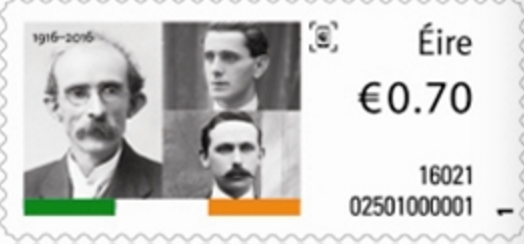
Regarding the top stamp, we see photos of Thomas J. Clarke, Séan MacDiarmada, and Thomas MacDonagh. Clarke was on the radar of the British government prior to the Rising as he had spent 15 years in prison. While in prison, he wrote his of experience of being an Irish prisoner in a British prison, where he had seen many of his friends descend into madness due to the no sleep torture the guards would use on the prisoners. He was a second generation Fenian and firmly believed that there could be no compromise with those who torture your people. MacDiarmada was part of the Irish Republican Brotherhood (IRB) and signed the Proclamation of the Irish Republic. MacDonagh was the Commandant of the 2nd Battalion of the Dublin Brigade of Irish Volunteers. He was also assistant headmaster of St. Edna’s School and a founding member of the Irish Volunteers. He was also a signatory of the Proclamation of the Irish Republic.
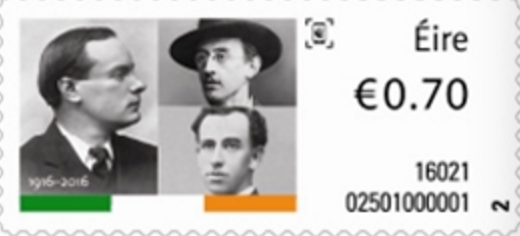
Regarding the next stamp, we see photos of Patrick Pearse, Éamonn Ceannt, and Joseph Plunkett. Pearse was an Irish teacher, poet, writer, nationalist, and political activist. He established the School of St. Edna’s in 1908; St. Edna’s was a bilingual school that taught in Gaelic and English since Pearse himself was a supporter of the Gaelic Language Revival Movement of the early 1900s. The school itself was built on the Hermitage, which was where Robert Emmet was said to have courted his beloved before his death. Pearse tended to gravitate towards the notion of Catholic martyrdom and tended to see himself as a Catholic martyr in the years leading to the Rising: “Life springs from death; and from the graves of patriot men and women spring living nations.” He believed that bloodshed was a cleansing process, not as a horrible tragedy, but as essential for the goal of independence: “Blood is a cleansing and sanctifying thing, and the nation that regards it as the final horror has lost its manhood…there are many things more horrible than bloodshed, and slavery is one of them!” He believed that death was inevitable and believed that Irish organizations should be armed in order to fight for liberty. The notion of bloodshed, so he imagined, was linked to masculinity purely because of the sublime component it possesses. In other words, one would become a man not only when he kills another man, but when another man kills you at the moment you are killing someone else. This notion of a double death was one he firmly believed in. After his execution, he became the ultimate symbol of the Rising. Plunkett had joined the Irish Republican Brotherhood (IRB) in 1915 and had also travelled to Germany to meet with Roger Casement regarding the import of German arms into Ireland for the Rising. This was considered a treasonous act because this was a time when World War I had been occurring for almost two years, meaning that anyone who associated themselves with the enemy, in this case Germany, was considered a traitor to the British crown. Plunkett was also an original member of the IRB military council that was responsible for the Rising gaining traction, and the council followed much of his plan outline when they carried out the Rising. Ceannt was also part of the IRB council. He was the Commandant of the 4th Battalion of the Volunteers as well as the Director of Communications.
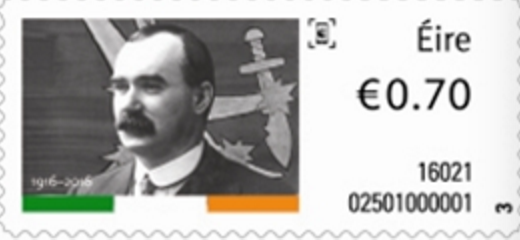
The last stamp depicts perhaps the most famous of the Rising’s leaders, James Connolly. Connolly was an Irish republican leader who was the Commandant of the Dublin Brigade. Since the Dublin Brigade was the most influential group participating in the Rising, the fact that Connolly was the main Commandant of the Brigade essentially made him Commander-in-Chief of the Rising.