Flags are born out of conflict. Flags are created to represent those who feel they lack representation. A group uses flags, as well as similar iconography, to make their ideology tangible both to group members and to outside, often times more powerful, forces. Flags serve to legitimize and unify the disenfranchised under a common goal.
Therefore, the history of national iconography is very much the history of conflict. Flags, in particular, literally and metaphorically rise and fall with nations. These pieces of cloth become so interwoven and central to the fabric of a population’s collective identity that flags become sacred and muster feelings of patriotism simply from gazing upon one’s own. And, as quickly as one’s gaze, the connotations of different flags can change.
The true power behind flags and national emblems stem from the ideology associated with it, patriotic or otherwise. The perception of flags convey emotions and ideas unique to the observer, yet they unite entire nations under a common goal.
The conflict arises when the observer’s perception of the flag they are assigned is not synonymous with the ideologies they possess. New flags are made for these new ideologies, making a group of like-minded individuals have something physical to represent their views. When those views oppose the views of the flag given to them, rebellion festers, people assemble, and flags are brought into battle.
When the people of Ireland chose to follow this route of violence to uphold the values of their piece of cloth, divisions were made between those who believed in an independent Ireland and those who believed in a British Ireland, nationalists and unionists.
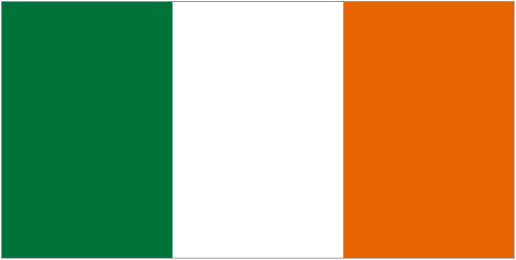
 The conflict of flags and ideology that began with the 1916 Easter Rising continues into the modern-day with literal lines being drawn to segregate along superficial lines. Religion, political beliefs, places of birth and family history all divide people in both the republic of Ireland and Northern Ireland. And, once again, the flags flown in 1916 are still used to delineate the sides.
However, flags, like any other symbols, inevitably change their meanings or message depending on who is flying them. The messages flags convey change with the times, and what may have been the message behind the flags in 1916 may differ from the messages in the future. Even the flags used in 1916 may depart from the original meaning presented at the flag’s inception.
Despite a flag or symbols ideological malleability and their close association with conflict of any kind, flags and symbols are not created to incite violence or intimidate. They begin as representations of people groups and the ideologies they harbor. Conflict only arises when those symbols are discriminated against, oppressed and invalidated by another group. Ewan Morris concludes his book Our Own Devices: National Symbols and Political Conflict in Twentieth-Century Ireland concludes by stating “A willingness to admit that the same symbol can be interpreted in radically different ways, and to explore the meanings which symbols have for others, is an essential precondition for reconciliation.” [1] The road to lasting peace is mutual understanding and coexistence of different people groups, not erecting walls and determining borders based on pieces of cloth.
See Also:
The Use of Flags in the 1916 Rising
Notable Flags involved with the 1916 Rising
The Modern Usage of the 1916 Flags
[1] Morris, Ewan. Our Own Devices: National Symbols and Political Conflict in Twentieth-century Ireland. Dublin: Irish Academic Press, 2003.