FOOD AND CIVILITY IN EARLY MODERN ENGLISH ACCOUNTS OF IRISH CULTURE
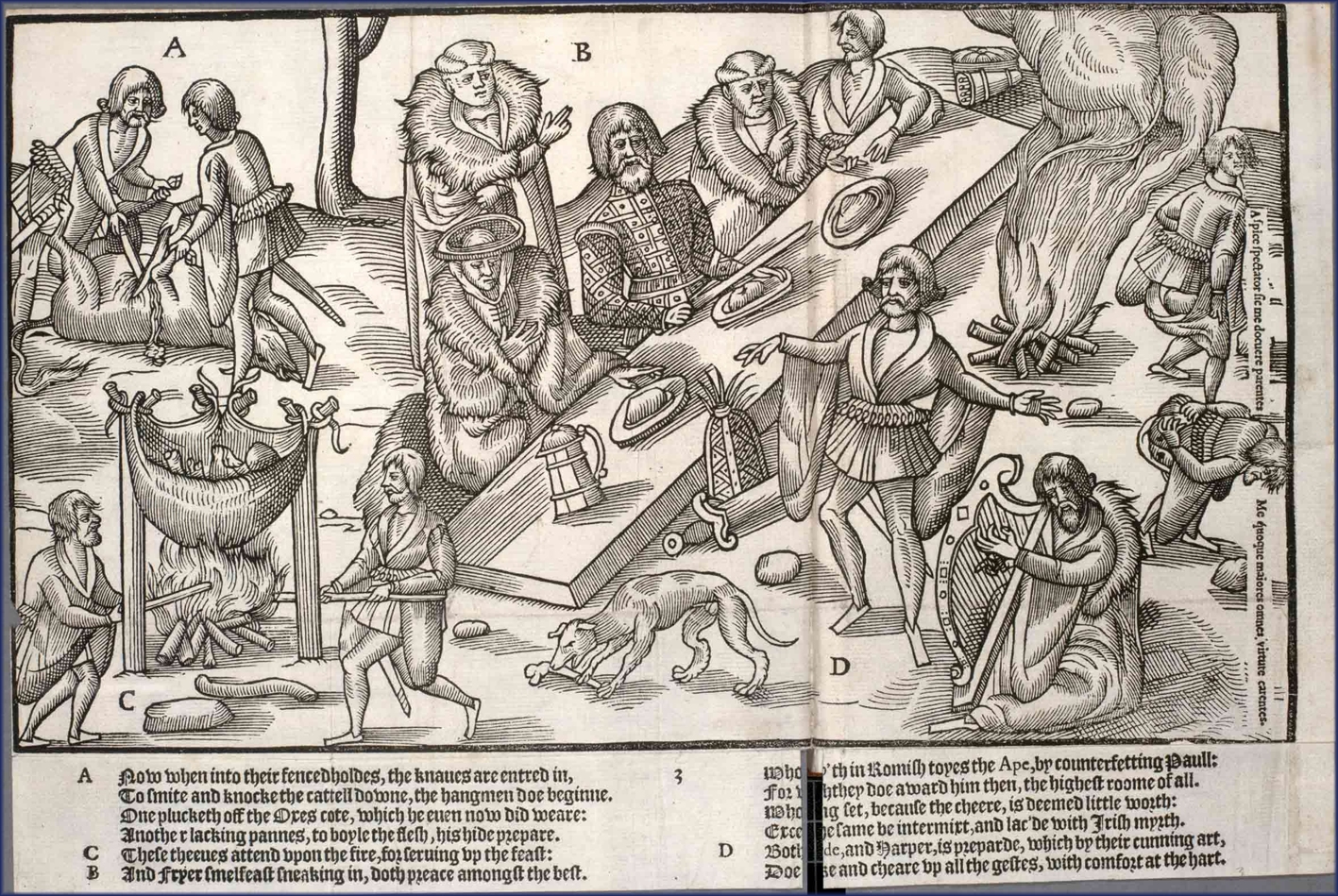 Image: Plate 3 from John Derrick, An Image of Irelande: With a Discoverie of a Woodkarne (1581)
Full text available here.
Reproductions of all 12 plates available here.
INTRODUCTION
In his 1581 tract entitled The Image of Ireland, the English poet John Derricke presented a memorable description of a 16th century Irish feast. This was, according to Derricke, a whiskey-soaked tumult staged to celebrate a brutal Irish assault on English settlers’ farms. In the caption printed with the image above, Derricke wrote [note: the letters in the poem refer to the lettered vignettes in the image]:
A) Now when into their fenced holds, the knaves are entered in,
To smite and knock the cattle down, the hangmen do begin.
One plucks off the dress coat, which he even now did wear:
Another lacking pans, to boil the flesh, his hide prepare.
C) These thieves attend upon the fire, for serving up the feast:
B) And Friar Smellfeast sneaking in, doth preach amongst the best.
Who plays in Romish toys the ape, by counterfeiting Paul:
For which they do award him then, the highest room of all.
Who being set, because the cheer, is deemed little worth:
Except the same be intermixed and laced with Irish mirth.
D) Both bard, and harper, is prepared, which by their cunning art,
Do busk and cheer up all the guests, with comfort at the heart.
According to Derricke, food customs reflected Irish incivility. Throughout his work, Derricke lamented the “wild shamrock manners” that prevailed in Ireland and called on his English readers to support the crown’s attempts to conquer and subdue the nation.[1]
This project focuses on the ways that Derricke and his contemporaries situated food within the wider discourse on Irish incivility and attempts to impose English rule over Ireland. For a period of about 70 years, from the 1580s through the 1650s, the question of how to bring the Irish landscape under English dominion and the Irish people into English civility was central to many observers. Names that are prominent in the early history of English enterprises in the Americas – for example Sir Philip Sidney, Walter Raleigh, Ralph Lane, and Humphrey Gilbert – began their careers as part of the Tudor conquest of Ireland. Prominent men of letters also attended to the “Irish problem”. William Camden and Raphael Holinshed, from whose chronicles Shakespeare drew much inspiration, both devoted considerable ink to describing the history of England’s incomplete conquest of Hibernia. Shortly after penning the Faerie Queen, Edmund Spenser likewise turned his attention to Ireland, proposing dramatic schemes for placating the unruly Irish. The prolific 17th century travel writer Fynes Moryson, devoted one-third of his four-volume Itinerary to ethnographic descriptions of Irish customs. His inspiration came from the several years he spent in Ireland as secretary to Sir Charles Blount, architect of one of the most brutal suppressions of the Irish in the early modern period.
Many of these writers identified food as a key category of ethnographic description. They asserted that the food consumed by what they termed the “native”, “wild” or “meer” Irish reflected and reinforced incivility. However, this was a strange kind of incivility. Unlike the savage, barbaric or uncivilized cultures that English writers claimed inhabited other parts of the world, the Irish had been exposed to the fruits of civility for many centuries, since at least the 12th century Anglo-Norman conquest. Thus, writers presented Irish incivility as a matter of choice – that is, the native Irish had chosen to reject civil customs – or worse, a matter of nature – that is, something ingrained within the Irish people made them impervious to civilizing efforts. Criticisms of Irish food focused particularly on what English observers deemed inferior modes of preparation, many of which reflected other, more serious perceived deficiencies in Irish culture.
[1] John Derricke, The Image of Ireland: With a Discovery of Woodkarne, ed. F.J. Sypher (Delmar NY: Scholars’ Facsimiles and Reprints, 1998), 8.