
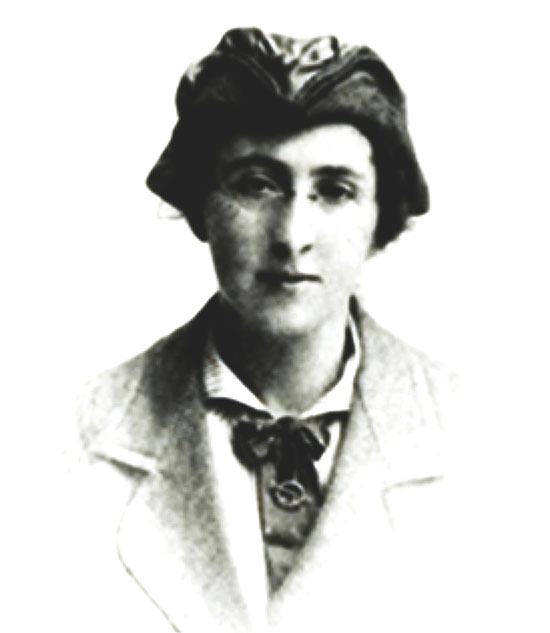
Margaret Skinnider was a good friend of Constance de Markievicz, born in Coatbridge, Scotland. As a child, she spent much of her time in County Monaghan where she read up on Irish history to understand the struggles of the people she saw all around her. She had been trained by the British to shoot in order to defend the Empire, a skill she would later use conversely to oppose it. She was a member of the Cumann na mBan and supported the start of the Rising by smuggling weapons into Ireland. She played an active, militant role in the 1916 Rising.
Similar to Countess Constance de Markievicz, Margaret Skinnider was an actively enlisted member of the Irish Citizen Army. Before the Rising, she had been given a revolver by Thomas MacDonagh which had been unfortunately confiscated by the British after the Rising. She was stationed at the College of Surgeons and had expressed interest in a more active role. Markievicz took this in stride, and as second in command to Michael Mallin, had Mallin assign a rifle to Skinnider. Skinnider then became a sniper, aiming at British soldiers hiding out in the Shelbourne Hotel saying,
“More than once I saw the man I aimed at fall”
(Ward 68).
Requesting a yet more active role, Skinnider proposed a plan to Mallin that through his hesitation he accepted. Skinnider planned to use her innocent looks to throw a bomb through the window of the Shelbourne Hotel and ride away on her bicycle. On her way there, she advanced with some men to burn down buildings along the way in order to halt the advance of British soldiers.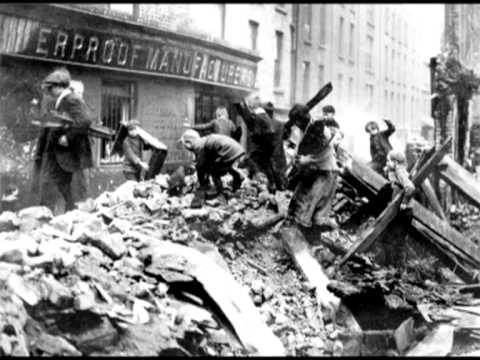
The small explosive that was thrown into the building called attention to their group. Fortunately, Skinnider had just turned to her left to call back to the men behind her when she took three bullets to her right side. William Partridge carried her from the line of fire to safety. Had she not turned, the bullets in her back would surely have been fatal. Margaret Skinnider was the only female wounded in action.

The legacy of Skinnider, although trailblazing in Rising history, is also one that makes us ask questions about gender expression and space during revolutionary history. Dissimilar to the example of masculinity set by Markievicz, Skinnider took advantage of her femininity in order to remain unquestioned at the scene of war and destruction; places of pure masculinity.
This brings out a duality in her womanhood: she was engaging in masculine and public fighting, arguably terrorism, which was able to ensue due to her womanhood. This is yet another example of how women, caught between two polar male and female spaces during the Rising, challenged the concepts of each realm to carve their own space and take advantage of gender performance.