Policing in Northern Ireland: The Ministry of Fear

Background

In his poem, The Ministry of Fear, Seamus Heaney recounts personal experiences from his time in grammar school under the watchful eye of his strict, Roman Catholic educators. Throughout the poem, his diction and allusions weave the narrative of his childhood education with the broader narrative of Catholics’ subjective experience in the primarily Protestant Northern Ireland. The harsh teaching style of his Catholic educators is meant to parallel the policing strategy in Northern Ireland at the time. Anything less than full cooperation with police, especially for Catholics, was met with swift and severe punishment, just as Heaney was punished by his teacher at school. The final two stanzas of the poem weave together the two narratives to give the reader a complete picture of how Heaney’s school experience serves as a microcosm for the broader historical issue of policing in Northern Ireland.

1. The Ministry of Fear [1]

(for Seamus Deane)

Well, as Kavanagh said, we have lived
In important places. The lonely scarp
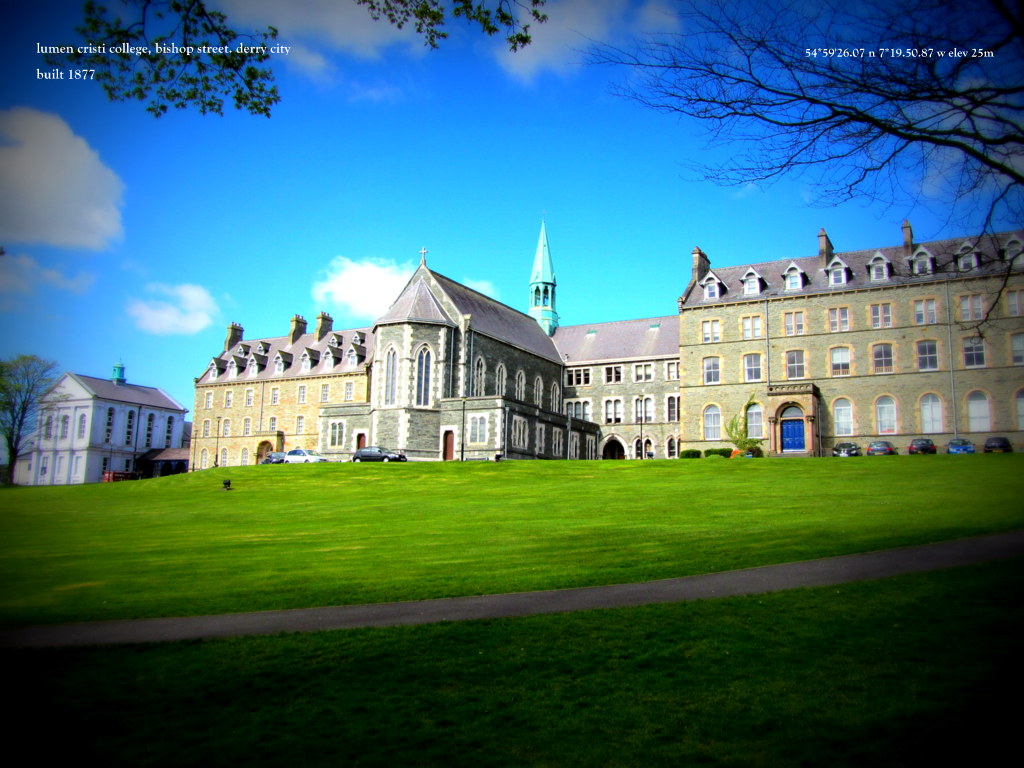
Of St Columb’s College, where I billeted
For six years, overlooked your Bogside [2].
I gazed into new worlds: the inflamed throat
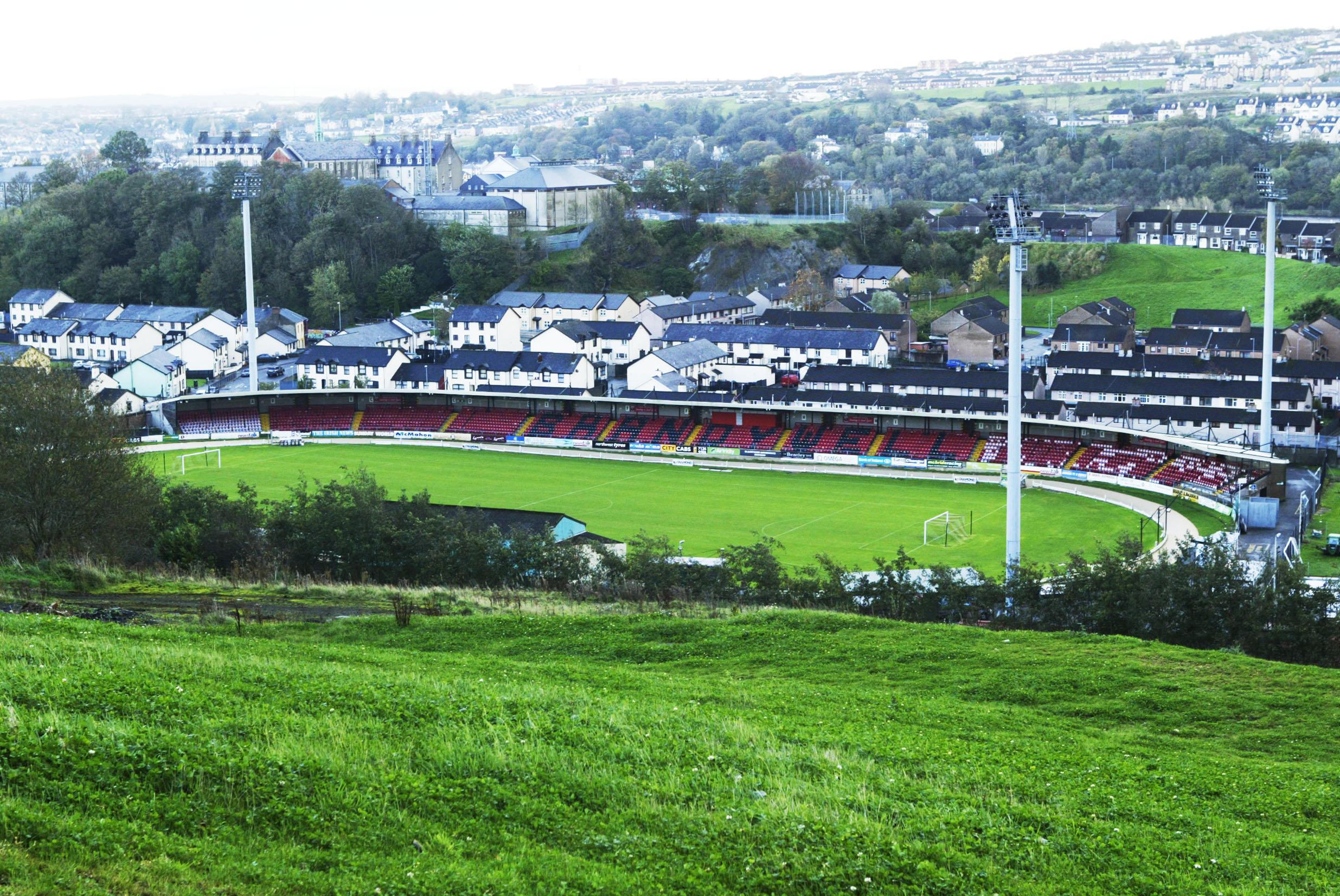
Of Brandywell, its floodlit dogtrack,
The throttle of the hare. In the first week
I was so homesick I couldn’t even eat
The biscuits left to sweeten my exile [3].
I threw them over the fence one night
In September 1951
When the lights of houses in the Lecky Road [4]
were amber in the fog, it was an act
of stealth [5].

Then Belfast, and then Berkeley.
Here’s two on’s are sophisticated,
Dabbling in verses till they have become
A life: from bulky envelopes arriving
In vacation time to slim volumes
Despatched `with the author’s compliments’.
Those poems in longhand, ripped from the wire spine
Of your exercise book, bewildered me—
Vowels and ideas bandied free
As the seed-pods blowing off our sycamores.
I tried to write about the sycamores
And innovated a South Derry rhyme
With hushed and lulled full chimes for pushed and pulled.
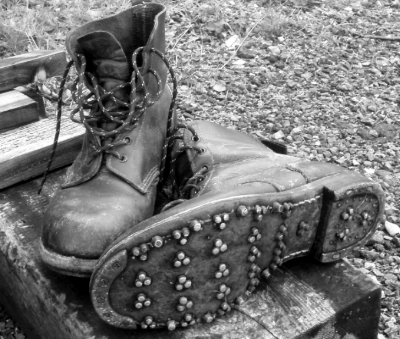
Those hobnailed boots from beyond the mountain
Were walking, by God, all over the fine
Lawns of elocution. [6]
Have our accents
Changed? ‘Catholics, in general, don’t speak
As well as students from the Protestant schools [7].’
Remember that stuff? Inferiority
Complexes, stuff that dreams were made on [8].
‘What’s your name, Heaney?’
‘Heaney, Father.’
‘Fair
Enough.’
On my first day, the leather strap
Went epileptic in the Big Study,
Its echoes plashing over our bowed heads,
But I still wrote home that a boarder’s life
Was not so bad, shying as usual.

On long vacations, then, I came to life
In the kissing seat of an Austin 16
Parked at a gable, the engine running,
My fingers tight as ivy on her shoulders,
A light left burning for her in the kitchen.
And heading back for home, the summer’s
Freedom dwindling night by night, the air
All moonlight and a scent of hay, policemen
Swung their crimson flashlamps, crowding round
The car like black cattle, snuffing and pointing
The muzzle of a Sten gun in my eye [9]:
‘What’s your name, driver?’
‘Seamus …’
Seamus?
They once read my letters at a roadblock
And shone their torches on your hieroglyphics,
‘Svelte dictions’ in a very florid hand.

Ulster was British, but with no rights on
The English lyric: all around us, though
We hadn’t named it, the ministry of fear [10].


NEXT: A Constable Calls

PREVIOUS: The Plain Truth 


[1] Heaney, Seamus. “Singing School.” Poetry Foundation. Web. 1 December 2014. http://www.poetryfoundation.org/poem/178022.

[2] The Bogside is the primarily Catholic part of the city of Derry, located outside the city walls.

[3] The use of the word “exile” implies that Heaney did not leave home voluntarily.

[4] Lecky Road is traditionally associated with Free Derry corner, an iconic symbol of the Troubles.

[5] Here, with the use of the word “stealth,” Heaney is emphasizing the climate of fear in Northern Ireland that made him nervous about even such a petty act as littering.

[6] Hobnailed boots were traditionally worn by those who lived in rural villages, such as Heaney. This reference is meant to invoke a sense that Heaney’s early attempts at poetry were not received well. His rough Irish language was, in the minds of others, trampling, “by God,” all over the English language.

[7] Heaney is invoking a sentiment that was common in his youth; he is quoting an anonymous adult figure who told him and others that Protestant children were better educated and thus spoke better. This further demonstrates the climate of fear, as Heaney was always made to feel inferior to his Protestant peers.

[8] Heaney is wondering how young Catholics such as himself could possibly have big dreams themselves when they were constantly being denigrated and reminded that they are less than their Protestant counterparts.

[9] In this stanza, Heaney is recounting a night spent enjoying summer’s freedom that was abruptly ended when his car came to a police roadblock. This is another example of the “Ministry of Fear” at work, as a young Heaney cannot even enjoy a night out without the fear of being aggressively confronted by armed police.

[10] Heaney is suggesting that despite Ulster’s strong cultural connection with England, he can still use the English language to his own ends. He goes on to say that while there was no formal name for what he refers to as “the Ministry of Fear,” it was a sort of zeitgeist that people at the time felt in their core. It was a reality without being recognized as such.

Roadmap
“Backseat Freestyle”

Kendrick Lamar presents several versions of himself on “Good Kid, m.A.A.d City.” The album’s songs can be understood as vignettes that characterize several aspects of Lamar’s identity. Tracks either frame Lamar as a follower or as an individual who has been alienated by police and gang violence. Stiff Little Fingers manipulates language to expose its absurdity while Lamar utilizes it to display his macho bravado. “Backseat Freestyle,” alludes to nights spent with friends driving around Compton, expressing their confidence by freestyle rapping.

There are issues in Lamar’s content however. There are several phallic images and misogynistic statements that Lamar makes. For example, in the song’s hook, Lamar states, “All my life I want money and power / respect my mind or die from lead shower / I pray my dick get big as the Eiffel Tower / So I can fuck the world for seventy-two hours.” This hook plays on multiple masculine tropes–intellect, violence, and virility. The song goes on to describe several ways in which Lamar exceeds in comparison to his peers, using masculine ideals as the basis for his supremacy. Lamar continues his macho assertion in the song’s bridge: “Goddamn I got bitches, damn I got bitches / Damn I got bitches, wifey, girlfriend and mistress.”   Yet, the imagery Lamar is invoking is not revolutionary in hip-hop. Hip-hop is known for intense misogyny, phallic language, and objectification of women in music videos. Lamar, in his own video, pays homage to this trope, promoting it as an authentic component to his music.

While hip-hop’s misogyny is problematic it reflects a deeper aspect of African-American living. In the beginning of the 20th century, when it was necessary for whites to re-imagine how America’s racial hierarchy functioned, Southern white men used gender to delegitimize African-Americans. These attacks were directly targeted at African-American men. In the south, for example, white men developed the notion of the “New White Man,” claiming it was a white man’s duty to protect white women from the hypersexuality of black men.

lynching
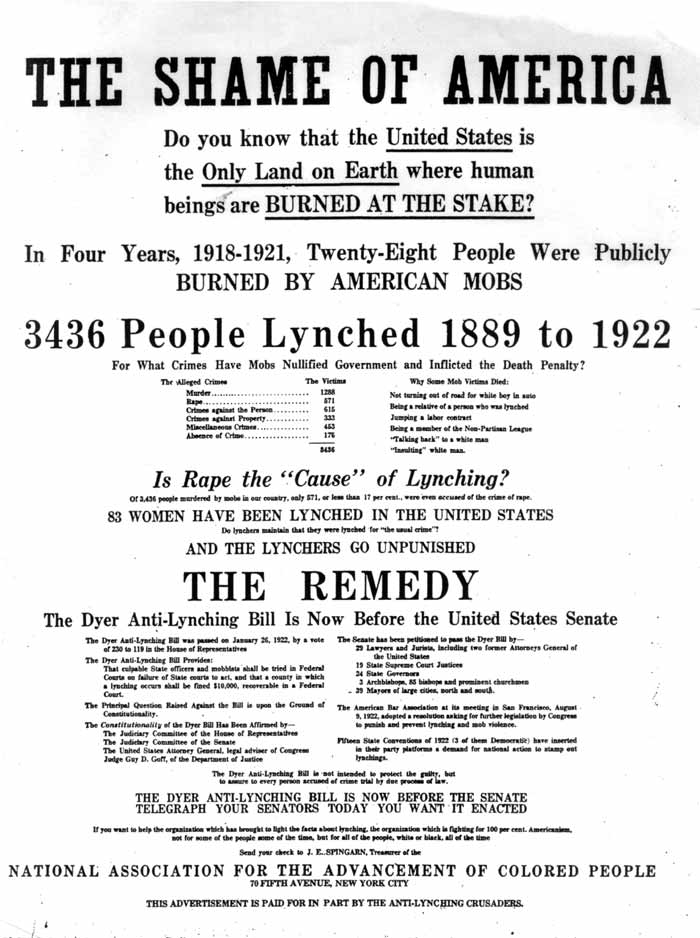
A pamphlet produced by the NAACP challenging individuals to think about the consequences of lynching and the South’s “black male rapist” narrative.

The fear of “black male rapists” emerged from this narrative, resulting in the lynching and castration of several black men in the South wrongfully accused of raping white women. Thus, hip-hop and its misogynistic language crudely reclaims the masculinity that was deprived by the country’s white male supremacy. Indeed, according to historian Glenda Elizabeth Gilmore, black men facing the “New White Man” had to “constantly…prove their manhood in order to maintain civil rights, even if they could never prove it to whites’ satisfaction.” Lamar’s misogyny illustrates Gilmore’s claim and perpetuates the African-American male necessity to constantly prove their manhood. Lamar’s lyrics and hip-hop’s content, therefore, illustrate the emasculating qualities of oppression.

[If you would like to refresh your interactive experience please pinback to the songs.]

“The Art of Peer Pressure”

“The Art of Peer Pressure” is the track that proceeds “Backseat Freestyle.” In our discussion of “Backseat Freestyle,” it was stated that Lamar used macho and phallic language to assert his bravado. The selfishness of “Backseat Freestyle” is juxtaposed with the selflessness of “The Art of Peer Pressure.” This track is the first on “Good Kid, m.A.A.d City” where Lamar gives a story about his experiences in Compton. “The Art of Peer Pressure,” according to Lamar, was meant “to take people on that ride, on that journey. It’s about being a teenager from L.A. and being influenced by your peers and who you’re hanging out with.” Lamar tries to assert his individuality with “Backseat Freestyle” but is contrasted with “The Art of Peer Pressure” which describes Lamar’s tendency to act violently or out of character because of his peers.

rosecrans
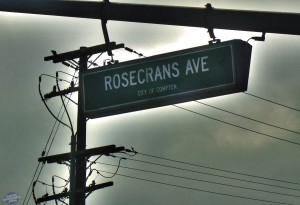
An image of Rosecrans Ave in Compton, California. The street is referenced throughout “Good Kid, m.A.A.d City” and is personified by Lamar as a crucial character in his stories.

In Compton, there is a tension for individuals to assert their individuality while maintaining a certain group identity. Individuals are swayed between this tension and challenged to act with their peers while also defining themselves from their peers. Lamar finds it difficult to remain true to himself because of peer pressure, recognizing that their actions have altered his personality: “…I’ve never been violent, until I’m with the homies.” Thus explains Lamar participating in a home robbery conducted by his peers. Lamar is aware of his personal qualities and morals but because of his group affiliation acts uncharacteristically, knowing that his actions are wrong. The juxtaposition between “Backseat Freestyle” and “The Art of Peer Pressure” reveals this tension and illustrates Lamar as consciously aware of his moral depravity at the result of his peers.

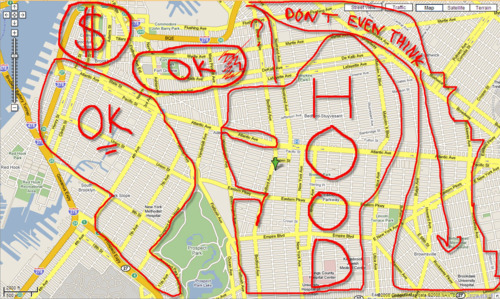
20th century American racism transpired into multiple institutions. For example, in the 1930s and 1940s the Home Owner Loan Corporation (HOLC) and the Federal Housing Authority (FHA), which was developed to protect and check homeownership, a significant part of the nation’s wealth, discriminated against minorities. The HOLC and FHA were the institutions responsible for approving and distributing loans. In the 1930s and 1940s, several communities that were made up of minorities were “redlined” and were labeled “unsafe” to live in. As a result, this made it very difficult for minorities to receive loans for their homes and dissuaded outside individuals to move and economically develop that region. Moreover, most of these locations were in urban regions. Thus, these practices caused a demographic shift in the middle of the 20th century, leaving several minorities in urban locales and caused whites to move into suburbia.

redlining
A crude illustration depicting how redlining redefined urban space.

These geographic and demographic shifts comparmentalized minorities into urban regions. As a result these locations which were typically economically deprived developed an “us vs. them” mentality among its residents. Lamar’s ideas on “The Art of Peer Pressure” contradict Stiff Little Fingers’ “Here we Are Nowhere” which champions a group mentality surrounded around punk music. The hopelessness associated with these new spaces caused several in America to join together and act with a group mentality to challenge and become more mobile within these confining spaces. Hence, came the gang culture that developed in Los Angeles, New York City, Chicago, and Lamar’s home of Compton. The gang, group mentality resorted to violence and crimes to address the wrongs that were deprived of them because of their geography. Lamar’s “The Art of Peer Pressure” unconsciously reveals this history and displays an individual who, consequently, is alienated by this gang mentality.

[If you would like to refresh your interactive experience please pinback to the songs.]

“Frederick Douglass…”

“Frederick Douglass…”

Frederick Douglass visited Belfast in 1845 and was both impressed by the lack of racial prejudice he was met with during his stay and felt connected to the struggles of the peasantry that he observed, though it is important to note that his experiences with race, “undoubtedly stemmed in large part from the fact that he was moving in the genteel, middle class Protestant milieu from whence Irish support for abolition stemmed” (Rolston, 446).

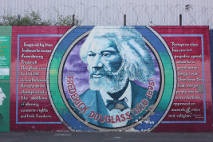
This mural was painted by Danny Devenney in 2006 and reads: “Inspired by two Irishmen to escape from slavery Frederick Douglass came to Ireland during the famine. Henceforth he championed the abolition of slavery, women’s rights and Irish Freedom. ‘Perhaps no class has carried prejudice against colour to a point more dangerous than have the Irish and yet no people have been more relentlessly oppressed on account of race and religion’- Frederick Douglass.”

Many groups that have fought imperialism looked to and were inspired by Ireland’s struggle, but particularly early on in the Irish republican movement (before the 1960’s) this support was not always reciprocated. Thus, while there were some abolitionists in Ireland, there were also many who rejected any attempts at fostering a brotherhood between the two causes: creating tension between, “the revolutionary whose emancipatory ideals are confined to his own nation, and […]  the internationalist who recognizes the plight of others in that of his own nation” (Rolston, 452).

However, this mural was painted well after this period, and was created in the tradition of murals with an international focus—thus abolition, women’s rights, and Irish freedom can be placed right next to each other without any pushback and Douglass’s visit to Ireland can be interpreted through a far more singular lens.

“Askatasuna…”

“Askatasuna...”
“Askatasuna…”

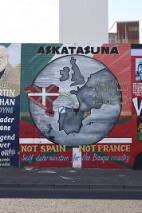
This mural expresses support for the Basque nationalists, and is one of a few murals in this vein. It, and murals of a similar tradition, read almost like political cartoons and are sorts of calls to action rather than agents of interpolation into a way of viewing the conflict in Northern Ireland within history. There are other murals like this addressing political issues in Nicaragua, Cuba, and Palestine.

Gerry Adams visited Basque in 1998 and though this mural was created in 2008, “The appearance of [earlier murals about Basque] coincided with efforts on the part of Irish republicans to support the Basque struggle for independence and subsequently to help broker a peace process” (Rolston, 459).

This particular image is focused on the sovereignty of the three regions of Basque and is direct in commanding, “Not Spain not France self-determination for Basque country.” The word ‘Askatasuna’ is the Basque word for freedom and in other murals was joined with the Gaelic word for freedom as well (Rolston, 459).

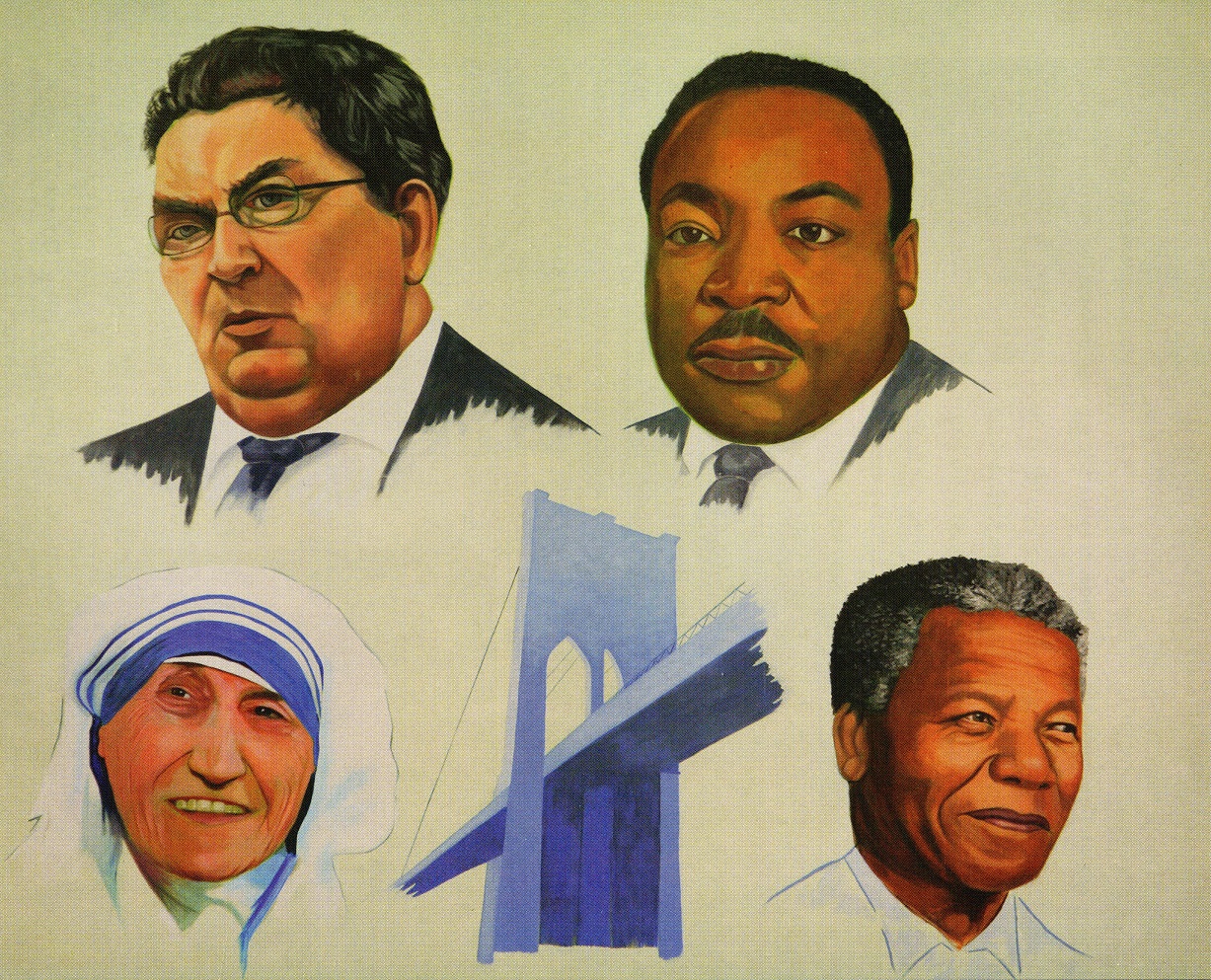
“A Tribute to John Hume”

“A Tribute to John Hume” was painted by the Bogside Artists in 2008 in an effort to depict Hume, “not as a politician or even as a popular leader but as a man of peace”

“A Tribute to John Hume”

(The People’s Gallery). John Hume was a key player in the formation of the Good Friday Agreement, a leader of the Social Democratic and Labour Party, Civil Rights movement, and a member of the Northern Ireland, British, and European Parliaments.

Hume is placed in the company of Martin Luther King Jr., Mother Theresa, and Nelson Mandela, all winners of the Nobel Peace Prize. This clearly positions him as a peace maker—as the Bogside Artists wanted. Each of these figures also had some involvement in Northern Ireland. Mother Theresa was educated in Dublin (The People’s Gallery), Nelson Mandela met with Gerry Adams in 1995, one of many, “Community activists and ex-combatants [who] traveled in both directions, observing developments and sharing views” as South Africa and Ireland developed through sometimes parallel struggles (Rolston, 463), and Hume cited Martin Luther King Jr. as his biggest influence, following in the tradition of, “Irish civil rights activists in the late 1960s [who] consciously modeled elements of their campaign on what Black Americans were doing contemporaneously” (Rolston, 464).

The other major element of this mural is the bridge which was modeled off the Brooklyn Bridge because of the, “belief held by many during its construction that it would collapse because of its span” and because according to the Bogside Artists: “Peace in Northern Ireland is to politics what the Brooklyn Bridge is to engineering, an almost miraculous achievement!” (The People’s Gallery).

“Good Kid”

“Good Kid” is the first track on “Good Kid, m.A.A.d City” to discuss gang and police violence as well as Compton’s drug culture. The track is sequenced with the song “m.A.A.d City” which builds off and develops the ideas on “Good Kid.” Lamar’s tone on “Good Kid” is much more manic compared to other tracks on the album. The hook describes Lamar’s outlook on Compton’s violence and drug culture as a “mass hallucination,” where the Compton experience is one of murkiness and ambiguity. Lamar is conscience of these absurd structures, understanding that they repress his ability to think clearly: “Look inside these walls and you see I’m having withdraws / Of a prisoner on his way trapped inside your desire / To fire bullets that stray…” Violence and drugs have distorted Lamar’s reality and constructed psychological boundaries that limit him to live autonomously.

Violence in Compton is perpetuated by gangs and police corruption. Thus, there are two spheres of violence Lamar faces that complicate his reality. Lamar on “Good Kid’ details his harassment by members of the Crips and Bloods, violent rival gangs in South Central Los Angeles whose blue and red colors resemble the blue and red of police sirens. While Lamar uses two separate verses to describe his experiences with gang and police violence the blue and red motif allows him to conflate these two spheres of violence as one holistic experience. The end of the first verse refers to Compton’s gang culture and states, “But what am I supposed to do when the topic is red or blue / And you understand that I ain’t, but know I’m accustomed to,” while the end of the second verse references police corruption and claims, “But what am I supposed to do with the blinking of red and blue / Flash from the top of your roof and your dog has to say woof.” The verse that deals with police violence, however, assumes Lamar must have some sort of gang affiliation to be a citizen of Compton: “And you ask, ‘Lift up your shirt’ cause you wonder if a tattoo of affiliation can make it a pleasure to put me through / Gang files, but that don’t matter because the matter is racial profile.” This line reveals a severe challenge Lamar experiences in Compton. While he disapproves Crips and Bloods’ violence, their actions have to come represent a larger narrative among policemen that associate gang violence with black male identity. Therefore, because of Lamar’s blackness he is immediately assumed to be a suspicious and potentially violent figure.

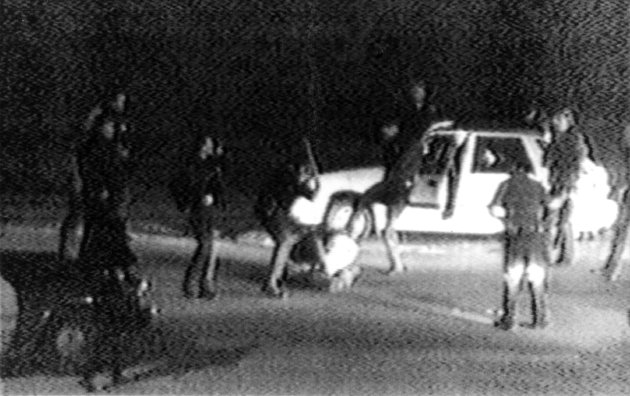
Rodney King2(1)
A still of the Rodney King beating in March 1991–one of the most notorious incidents of police brutality in contemporary America.

Lamar’s psychological boundaries are further complicated by Compton’s drug culture. Drugs act as a coping mechanism to the violence Lamar experiences. Lamar, at the end of “Good Kid,” states “When violence is the rhythm, inspired me to obtain / The silence in this room with 20’s, Xannies and ‘shrooms.” The substances that reorder Lamar’s psychological boundaries are superficial and illustrate an individual who is unable to use their own agency to remove these structures. Lamar, however, is aware of this deficiency when he claims “The streets sure to release the worst side of my best,” knowing that these structures eliminate his ability to identify himself and have the autonomy to do so. Substance abuse does not reinforce these psychosomatic borders but, rather, illustrate Lamar’s inability to correctly address internal structures that are altered by social forces. This idea contradicts Stiff Little Fingers “Here We are Nowhere,” which states that individuals take the agency to effect their space and bodies utilizing the punk ethos. Lamar, unfortunately, is a jaded, internally inept individual who is self-consciously aware of the identity Compton proscribes to him. Lamar’s experiences with violence and drugs, opposed to Stiff Littler Fingers contempt for boredom, have left him in a much heavier and more complicated state of oppression.

[If you would like to refresh your interactive experience please pinback to the songs.]


“m.A.A.d City”

This track is the 8th off of Lamar’s album. In an interview with Complex magazine, Kendrick explains how the acronymed title has two meanings – My Angel on Angel Dust and My Angry Adolescence Divided. Seeing as how this is both the track title and one half of the album name, it is apparent that these intermingled ideas on personal and environmental struggles, honoring where you came from while figuring out who you are. The violence of Compton comes through in the lyrics, but the featuring of Compton born old school hip-hop artist MC eiht proves that Kendrick doesn’t want to throw away his heritage as he struggles to find his own identity.

Violence pops right out at the listener as soon as they turn on the song – “If Pirus and Crips all got along / They’d probably gun me down by the end of this song” opens the track. The first thing Lamar does is establish the normalcy of violence in his ‘mad city’ of Compton. While the most pervasive idea of the rest of the song is the danger of drugs, the mindless violence associated with that is a close second. This Kendrick goes on to relate stories and rumors – “The driver seat the first one to get killed / Seen a light-skinned nigga with his brains blown out” and “Joey packed the nine… We adapt to crime, pack a van with four guns at a time” and “A wall of bullets comin from AK’s, AR’s, “Aye y’all. Duck.” to reference a few. This rapid fire offering of violent scenes is also seen in Stiff Little Fingers’ “Wasted Life”, with constant reminders of fatal gun use and violent situations. These continue throughout the song, offering the picture of a past that makes the listener wonder how Lamar got out alive. He likens the kids he grew up with to the Children of the Corn, an unflattering comparison to pure fanatical violence and evil. Despite all of these brutal renderings of his city, Lamar refuses to be removed from Compton; he refers to himself as “Compton’s human sacrifice”, offering his life to the violence of the city he loves.

Lamar’s unbreakable connection to his heritage seems to be the key to why he accepts this violence. He takes it as an immutable part of his past, something that cannot be changed so it might as well be embraced. It is interesting to note that while Lamar accepts the violence of his past, Stiff little fingers “Wasted Life” and “Closed Groove” do just the opposite. While both albums depict violence, Stiff Little Fingers seem to push back against the idea of remembering their heritage, trying to distance themselves from their origins. With the very first verse Lamar invites the listener to “take a trip down memory lane” with him, to follow him as he remembers where he grew up. He names friends and enemies, experiences and conversations, family and drug culture all flowing together. This entire song is about the violence of his heritage, his origins and his roots in this action. The song is honest – Lamar does not lie about the situation of his upbringing but offers a bluntly real view of where he came from with all of the ups and downs that he recalls, for better or worse.

While talking about the past offers a clear link to heritage, the inclusion of MC eiht strengthens the idea of accepting heritage. MC eiht was a member of Compton’s Most Wanted, considered a pioneer in the West Coast rap scene as the genre was blowing up across the nation. To bring MC eiht back onto the scene gives proof to Lamar’s lyrics. Now he is not just talking about honoring his heritage, but he is acting on it, honoring Compton’s past through the use of old-school rappers. Lamar grew up as Compton’s Most Wanted released CD after CD, side by side in Compton. As Lamar went through these experiences and trials, it is easy to imagine tracks like “All Around the Hood”  blasting through the car speakers.

Against this wish to embrace origins was a drive for Kendrick to create his own identity, remembering his origins while still becoming his own man. In Stiff Little Fingers’ “Closed Groove,” identity is formed from a shunning of heritage, leading to empowerment of the artist as an individual; in “m.A.A.d City” it seems that identity stems mainly from ideas of heritage while the artist simultaneously struggles against this. Lamar includes a repeated hook that showcase the importance of identity – “Where you from, nigga? Fuck who you know, where you from, my nigga? Where your grandma stay, huh, my nigga?” His “trip down memory lane” is his answer to these inquires explanations of who he is through his memories – his identity is not removable from his heritage.

Despite this, Lamar tries to remove the two from each other. He references himself in the third person a few times, trying to juggle respect for his origins and being true to himself. The line “you know the reasons but still won’t ever know my life / Kendrick AKA Compton’s human sacrifice” portrays this struggle perfectly. The listener can receive all of this information on the artist’s past but still not know the person. At the same time, the artist is a part of the city until death. Identity is irremovable form heritage, and violence is irremovable from heritage; all three are bound together, but an understanding, acceptance and balance makes it all okay.

[If you would like to refresh your interactive experience please pinback to the songs.]

The Art of Oppression: An Examination of Kendrick Lamar’s “good kid m.A.A.d city” and Stiff Little Fingers’ “Inflammable Material”

Jon Hamblin, Jacob Kotler, and Tim Maloney

27z8z8z

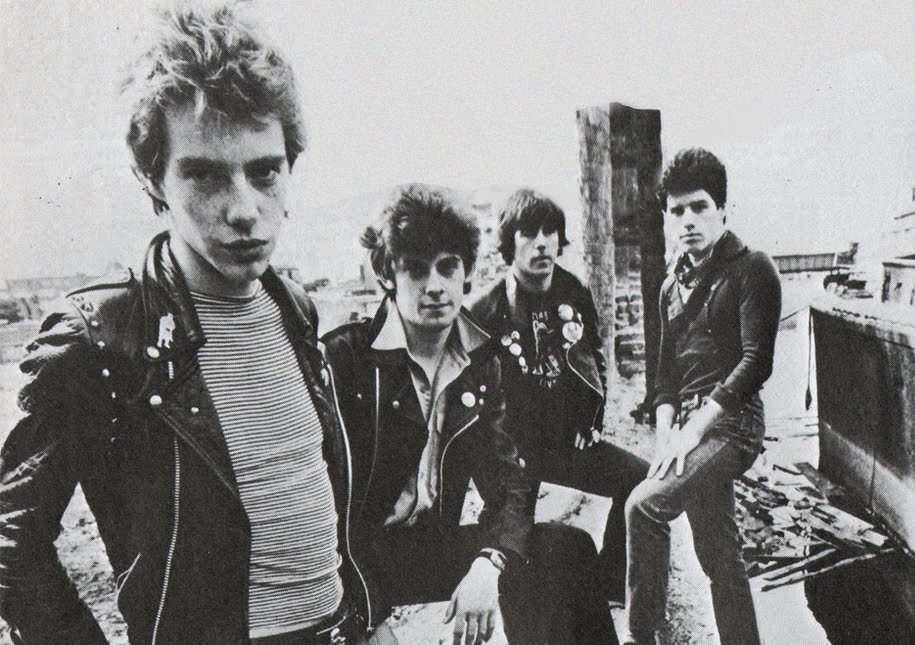
stiff-fing-stiff-little-fingers-33255753-915-645

A study of Northern Ireland might cause Americans to pause and reflect about their own ghettoes, to wonder what could happen in a land where, 40 percent of black teenagers were out of work.

-John Conroy

Every time you clock in the morning, I feel you just want to kill
All my innocence while ignoring my purpose to preserve as a better person
I know you heard this and probably in fear…

-Kendrick Lamar

This project utilizes two albums to examine different responses to states of oppression–one from hip-hop and another from punk.

The hip-hop album in our study is Kendrick Lamar’s 2012 album “Good Kid, m.A.A.d City”–an album that was heralded by critics for its complex, creative, and detailed interpretation of life in Compton, California. Kendrick details the city’s police and gang violence, his tendency to be peer pressured, and his adoration for Compton, knowing that aside from the violence, his home was a crucial factor in developing his character. “Good Kid, m.A.A.d City” has been championed for its homage to early 90s hip-hop, considered by many to be the genre’s golden age. The record is known for its “authentic” hip-hop sound and seen as a continuation of an African-American narrative that tackles the complexity of race.

The punk we look at is Stiff Little Fingers’ 1979 album “Inflammable Material.” “Inflammable Material” is considered by many punk enthusiasts a quintessential punk record. The album, like Lamar’s record, details experiences growing up in a violent urban setting: Belfast, Northern Ireland. However, compared to other punk bands that tend to be more nihilistic about their environments, Stiff Little Fingers had pride for Belfast, their songs reminder listeners they have the agency to alter Northern Irish reality. “Inflammable Material,” while also dealing with the violent Northern Irish Troubles, used punk as a vehicle to criticize and impacted how listeners inside and outside of Northern Ireland understood Belfast.

It is our intention that this study will yield a more complicated and varied understanding to the dynamics of oppression and the artistic responses to it. However, we want to avoid a horizontal analysis of these albums. We realize there are several differences between America’s racially-charged discrimination and Northern Ireland’s religious-based conflict between Irish nationalists and Northern Irish unionists. Moreover, we also understand that these two albums are single interpretations of incredibly rich and historic conflicts.

Therefore, for our project, we have chosen a few songs from Lamar’s “Good, Kid m.A.A.d City” and Stiff Little Finger’s “Inflammable Material,” highlighting several themes we believe allow a better understanding of these conflicts and, most importantly, the nature of oppression. These themes include physical violence, identity, heritage, authenticity, masculinity, and isolation.

To avoid a side-by-side analysis our project is designed in a web format. Each song page will reference lyrics and contain an analysis of the material using historical evidence and other media to support our ideas. Pages will also include hyperlinks that connect songs together via similar themes. The hyperlinks will give you an option to either look at a different song by Lamar or Stiff Little Fingers, giving the reader a much more interactive experience with the content. Thus, our project is a vehicle to introduce these themes and not interpret them. These albums are art and there can be no catch-all argument that addresses their intricacies. We believe by framing the study as a web we can give readers their own interpretation of these complex songs and the subject of oppression and urban conflict.

Now, we will introduce the songs. 

Patriot Games on IRA Focus – Dowon Hwang

While Patriot Games gained popularity for its action and excitement, its audience was shielded from historical accuracy and background. Patriot Games included little to no content of the Troubles, the IRA’s reasons for the violence depicted in the movie, and the unfair demands made by the British during the peace process. To Irish Republicans the IRA represented freedom and justice for their own land and leadership from the British.

Similarly to Americans during the Great Revolution, Irish Republicans dreamt of becoming their own independent nation. Because the British were so uncompromising, the IRA had to resort to violence as a way to make their voice heard. While killing people in Northern Ireland with bombs and attacks against the British, the IRA sacrificed their own people which confuses outsiders and even people well-informed of the IRA. However, it has been a tactic for them as it is a common belief to supporters of the IRA that the “end justifies the means,” as Aoirghe from Eureka Street claims. (McLiam Wilson 293).

Patriot Games failed to incorporate the repression Irish Republicans experienced from the British Unionists in their own country causing the IRA to persist with their violence. Rather, Noyce focused on entertainment and dramatizing history by making the IRA the “bad guys.” The Irish Republican Army (IRA) in Patriot Games, consisting of characters Sean Miller, Kevin O’Donnell, and Annette portray them to be power-hungry and vicious.

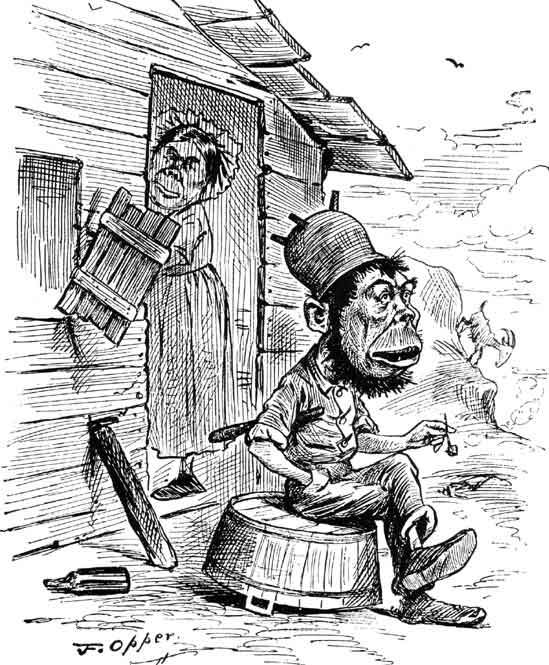
Similarly to the way Irish were depicted to the outside world for the past few hundred years, the IRA was depicted as inhumane in the photo below titled, “A King of Shanty” found in thesocietypages.com. The Irish were dehumanized for centuries as they were often compared to monkeys, apes, and in this caricature, an African American tribe who the artist perceived as little different from primates. Apes and monkeys were used to stereotype what the Irish were as a nationality because of the physical traits and mental capacities of what the primates were born with and those the Irish were perceived to utilize. Primates are physically unattractive with their bodies covered with dark hair and broad facial features and the Irish were perceived to the British as lazy and unkempt. This comparison was used widely by Americans and the British because of Britain’s oppressive influence over Ireland. This parallels Patriot Games’ depiction of the IRA as the movie dehumanizes the physical traits of Sean Miller, a member of the IRA. Of the multiple visual insights included in Patriot Games to depict the IRA as villainous, one that particularly stood out showed bloodshot eyes of Sean Miller at 2:27.

Along with the visual insights depicting the IRA as inhumane, movie reviews also depicted them as inhumane through diction. Rottentomatoes used the term “neutralize” while reviewing the movie. This indicates the subject of the matter to be wild and undomesticated as they need to be tamed. Also, the method of taming is unnatural, implying that a natural force is not strong enough to contain the disruption. Rottentomatoes also wrote of Sean Miller to exhume “the wrath of a maniacal Irish radical,” which states he has an unstable mental state.

Along with Rotten Tomatoes, New York Times’s critic Janet Maslin acknowledges Patriot Games’ portrayal of Irish Republican Army to be the “bad guys.” (Rottentomatoes 1992).This is evident as she wrote, “On the other stand Irish terrorists who, in the absence of the kinds of cold-war villains who populated Mr. Clancy’s “Hunt for Red October,” are the author’s best exemplars of the forces of anarchy and evil.” Tom Clancy, the author of Patriot Games, is well known for his action thriller novels and because each novel of this sort needs a protagonist, he had to exaggerate the actions and means of the IRA.

Maslin is better-informed of historical background of Northern Ireland as her review shows. Unlike the critic of Rotten Tomatoes, she gave mention to Patriot Games’ diversion from historical accuracy of the IRA. (Rottentomatoes 1992). She wrote, “The Queen of England owes a debt of gratitude to the makers of “Patriot Games,” the sleek film adaptation of Tom Clancy’s best-selling paranoid thriller,” which provides readers with her knowledge of tension between the British and the Irish or rather the Protestants and Catholics. In both reviews critics (who represent the audience) project what they perceive the movie to be to Americans who in turn read and if little knowledgeable of the Irish Republican Army, will believe the review and the situation to be reality.

Irish Echo, the oldest and most widely read American-Irish newspaper in the United States, dug deep into the novel that this film is based on. Identifying that the IRA were portrayed in the film as “crazy, bloodthirsty Irish terrorists stalking suave and civilized British royalty” (O’Hanlon 16 Feb 2014), O’Hanlon, the author of the article, made it apparent that there was a great misrepresentation felt by the Irish-American citizens in the United States.

However, O’Hanlon does not totally blame Clancy for this misrepresentation, as he acknowledges that “Movies, of course, don’t always fully reflect the books they are based on and that may have been the reason why Clancy more or less escaped the widespread annoyance felt by Irish and Irish Americans alike over the way that different nationalities were portrayed in the movie.

Although Clancy may not have intended for the IRA to look and feel as vicious as they did in the movie, the fact that the IRA was so monstrous only plays into the idea that Hollywood is willing to exaggerate history to make for a more thrilling drama. Director Phillip Noyce included the ugly nature of the IRA, the killing and bombings, without giving them a proper purpose in the film. This depiction of the IRA, as a blood-thirsty organization, is a great misrepresentation felt by movie critics, Irish and American, across the United States.