The eye is first drawn to the orange oval in the center of the print. Within this oval is a depiction of a woman; this woman is Erin, serving as the physical manifestation of Ireland. The use of depicting Ireland as a female is a tradition meant to convey a surge of protectiveness among men in order to convince them 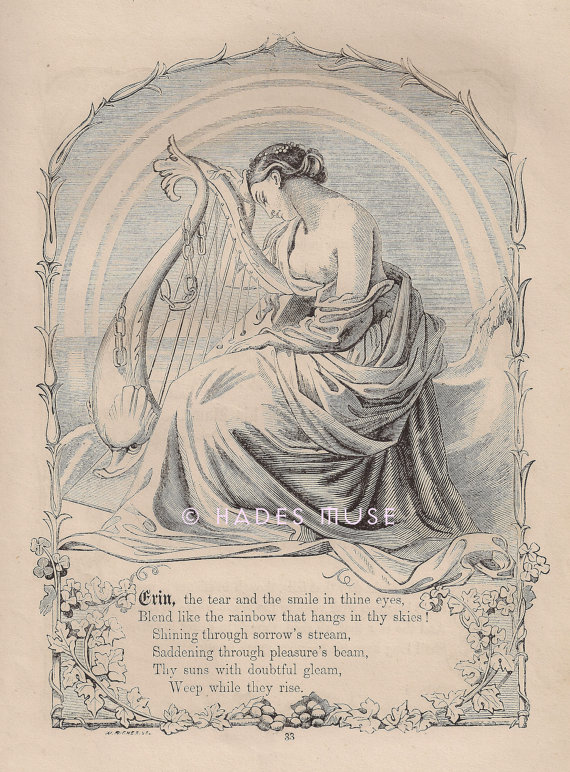 to fight in Ireland’s defense. This was seen in W.B. Yeats’ play, Cathleen ni Houlihan, performed in 1902, and was set in 1798 rural Ireland. In this play, Ireland is first shown as an old woman, tired from her travels, and arriving at the doorstep of a small peasant family, the Gillanes. After the family invites her inside, she begins to tell the eldest son, Michael, about how her “four beautiful green fields”[1] were taken from her. The four fields to which she is referring would be the four provinces of Ireland itself: Connaught, Munster, Ulster, and Leinster. The fact that the old woman made a point of saying that they were “taken” from her implies that the British unlawfully stole land that rightfully belongs to the nation of Ireland.
[1] W.B. Yeats, Cathleen ni Houlihan (London: A.H. Bullen, 1906).