
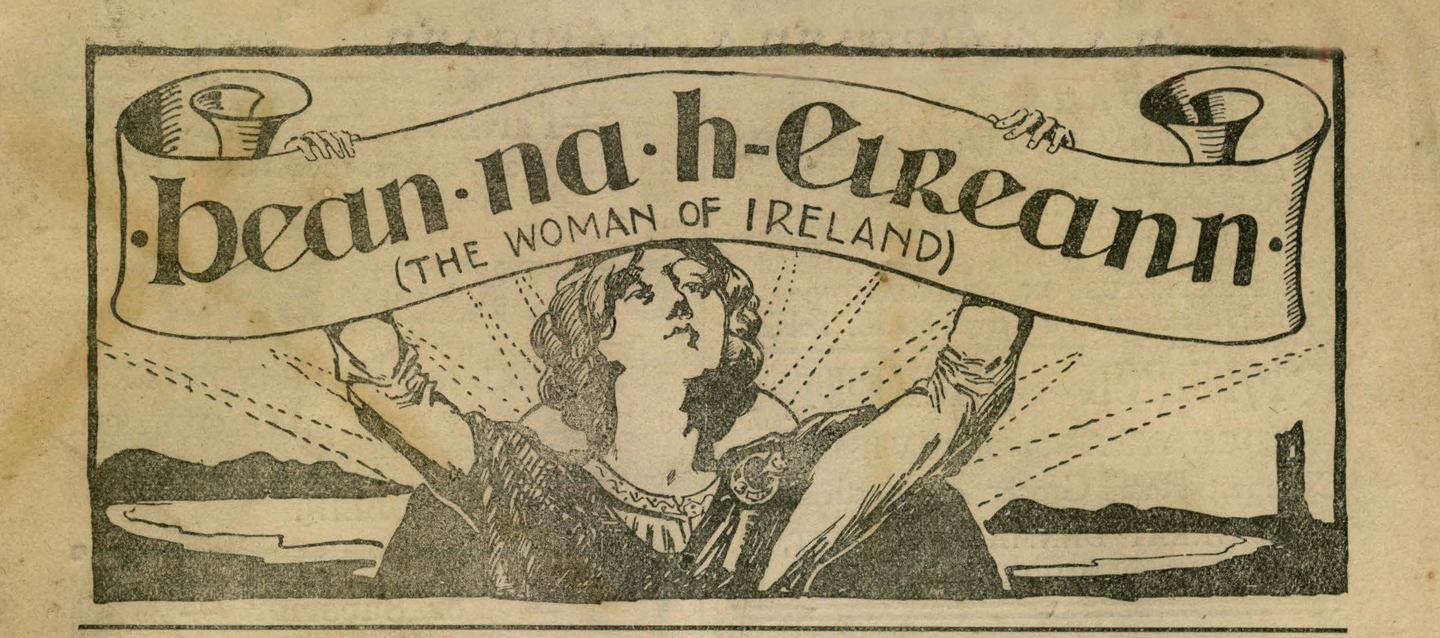
Our basic understanding of gender issues in the Rising is coupled with the understanding of the Irish family unit, which like any cultural unit, ebbs and flows depending on political and economic circumstance. The heterosexual family unit was reinforced both by Christianity and its patriarchal system, and also by British colonialism—a force of penalization and division of land.
The family, as the “primary unit group of Irish society,” can also be seen in the Foucaultian lens as a capitalist venture nearing the eighteenth century, as the global capitalist system comes to a full head, and the family provides stability of labor in the growing need for a steady workforce. One can argue that this, coupled with Catholic understandings of women and reproduction, is an implicit push for fecundity while also decreasing the agency of women over their own bodies.
The increasing rigor of the capitalist system left the less affluent more reliant on the family unit, factoring into the pattern of the closing in of the Irish family cell, which was especially strong starting in the eighteenth century. In this system, women were a central part of the family economy but often uncompensated or unrecognized for their contributions. In addition, gender ideas of the woman and man move away from the hierarchal (man over woman) ideology, the spheres increasingly bifurcate (woman’s space vs man’s space). This placed women into the private sphere even if they participated via economic activity or made themselves public— Conrad describes this when she remarks:
“Women in the public sphere were subject to more scrutiny than men, particularly if their actions were seen in any way to undermine the family unit.”
Foucauldian understanding of the twentieth-century hysterization of women’s bodies, brought on with new psychological discourse spearheaded with Freud, which Foucault describes in the History of Sexuality as:
“a threefold process whereby the feminine body was analyzed—qualified and disqualified—as being thoroughly saturated with sexuality… whereby, it was finally placed in organic communication with the social body.”
In this way, “science” was used to “diagnose” who did not directly conform to society’s expectations for femininity and domesticity, and placed them on the outside. During this intellectual era, evolutionary science also appeared , and in the ways of social Darwinism racialized the Irish (Catholics) and other colonized peoples. Rhetoric was used to describe the Irish as emotional and sentimental. Matthew Arnold characterized the Irish race as feminine, playing into a larger trend of imperial discourse.
This imperial understanding of the family allowed the masculine family image to be transferred into concepts of nation—children grow into adults, and the nation grew with it in an orderly way of “Progress,” legitimating violence against the Irish problem as one of the “political trope of marriage.”
In the nineteenth and going into the twentieth centuries, the family cell turned into a Revolutionary Cell that could create more nationalists, perpetuated by the trope of mother Ireland and her fecundity. In this way, women had a right to sexual expression but only in the context of the family because it is breeding Revolution.
This type of rhetoric was one of the key ways in which women were turned into nationalist symbols instead of actors who could perpetuate their own destiny—clearly seen in works like “Mother” by Patrick Pearse who paints the mother as an almost-Mary figure who feels no remorse over her sons going away to die for a revolutionary cause, turning her into a one-dimensional woman without real ideas, worries, or grievances. She does not grudge her sons going out “to break their strength and die” for the sake of Ireland.
This clearly nationalist rhetoric paints the woman and the mother as a Mary-like symbol that also doesn’t have the whims of a normal human mother, like grieving for a son going to war or being worried about her child—traits of objectification that are exemplifying of his use of religious metaphor to bring substance to a largely abstract fight.
The same can be said for Yeats’ Cathleen ni Houlihan, which shows us how Irish modernity used the body of the woman to represent an ideal Ireland because nationalism can only be perpetuated if it is presented in some sort of tangible way. The female body serves this purpose in the play, taking agency away from women for use as a revolutionary symbol of chastity and pureness, but also strength.
It held the semblance of feminism, especially through the physical force nationalist Maud Gonne, who channeled both of Yeats’ yearning for her as a symbol of perfection, and her realness as a Sinn Feiner.
The Revolutionary family cell was reinforced by two different discourses: one, that Ireland was a fragile or weak woman that needed to be saved by her British colonial invader, which painted Britain as a dangerous figure or even rapist; and two, that the woman as Ireland was a potential threat to the family and needed to be tamed by men. The latter can be inferred from Yeats’ Cathleen ni Houlihan: she is an ideal image of Ireland in the form of an old woman, although one could argue her promiscuity was her downfall since she has ‘let strangers into the house’, and therefore she must be controlled by the masculine figure of the revolutionary who will set her straight.
In this way, the incessant symbolization of women as threat left Republican or suffragette women, as a threat to an idealized vision of Ireland, and so the perpetuation of this ideal partially worked to delegitimize them within the context of nationalism. These women simply did not have a framework to be incorporated into.
Understanding the family cell gives us a clue into the culture that framed Ireland pre-Rising, but there are other spaces to address. We can think about cells not only as a family unit but also as literal spaces where women were either incorporated into or left out of during the Rising and its following processes.
Similar to the working of the family cell, the Revolution can be understood as a distinct space that men dominated and women wished to and seldom entered. The terminology of space, site, and territory work not as metaphors in the revolution but as actual physical spaces—in order to take part, women had to be affiliated with a certain outpost or garrison. In these ways, gender hierarchies were replicated in these spaces as women were often not allowed near the front line and were often told when they could leave the kitchen, etc.
The Post-Rising climate represented a challenge in that the work of nationalist women was barely considered in drafting the new government, except to limit their citizenship through legal means. According to Maryann Gialanella Viliunus,
“The free state enacted gender legislation which tried to remove women from participating in the economic and political life of the state.”
Women vocalized their complaints with this lack of incorporation—in 1937, Bridget O’Mollane complained to de Valera about the constitution, saying that it does not acknowledge any of the physical contributions to Rising while also claiming them as inferior—those clauses were removed, but the era that followed the event that women so heavily participated in did very little to acknowledge them. Those achievements still now acknowledged in any subsequent legislation, even though the Proclamation granted “equal rights and equal opportunities.”