Many idealize Ireland after reading “The Lake Isle of Innisfree” and other romantic pieces, but in reality, Ireland has no true “essence”. The writings of J.M. Synge exhibit this especially well; in searching for the “true Ireland,” Synge seems to contradict himself on several counts. He showcases the Aran Islands as a collection of quant villages inhabited by simple people, but goes on to show that there is actually more to the population than he thinks. Synge quickly runs into a core problem of the essential in his attempt to depict the Aran Islands and their people in a traditional manner: the complexity of humans and of societies.
In an excerpt of The Aran Islands, Synge begins by describing his current writing environment; “I am in Aranmor, sitting over a turf fire, listening to a murmur of Gaelic that is rising from a little public-house under my room” (Synge 1907). Immediately, he has set the scene for a charming tale of the quaint Irish people living simply in their barren, rainy landscape, and from here he starts to make an attempt at exploring their world.
Standing in Doolin looking out at Inisheer, it is easy to imagine the land as Synge saw it over 100 years ago. The land is nearly useless to humans; it cannot effectively be cultivated, it is difficult to build on, and it doesn’t offer much in the way of shelter. As a result, it was scarcely populated in Synge’s time, and still is today, save a few wandering tourists attracted by authentic hand-knit sweaters or passing students eager to escape stuffy classrooms.
Synge’s writing paints a vivid picture of the local land and population of the Aran Islands, describing in detail everything from their linguistic proficiency to their dress to their attitudes towards the Spanish American war. In doing so, he provides a source of vague uncertainty for readers projecting their own uninformed views on the archipelago. Bouncing between issues of globalization (trading with the mainland, stories of people who have left the island, and their curiosity of outside conflicts) and localized culture and apparel (he speaks of communication difficulties with Gaelic speakers, and of the “pampooties” worn as footwear by the locals), he demonstrates the complexity of the society, despite its relatively isolated and simplistic status.
In constantly moving between larger and smaller viewpoints like this, Synge consistently goes against the expectations of the reader, whose views are challenged each time these switches occur. His continues to underscore the initial impressions that he offered of the islands each time he makes these juxtapositions, and that is one of the things that truly makes this piece fantastic.
The Aran Islands demonstrates the flaws of thinking about Ireland in an essential way. Synge intended to challenge people’s perceptions, and his writing succeeded in laying the groundwork for this. Ireland and its people don’t have an essence any more than those in the United States, Great Britain, France, or China. They are just people, living their lives like all the rest. The Irish are the same as they always have been: proud, conscious, and human.
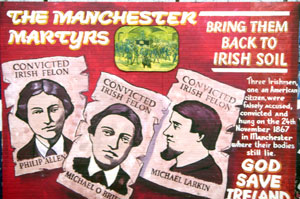
“God Save Ireland” was first arranged by T.D. Sullivan in 1867. It was written in the wake of the Manchester Outrages in the same year, during which three members of the Irish Republican Brotherhood (Michael O’Brien, William Philip Allen, Michael Larkin) were hanged for the murder of a Manchester police officer (Sergeant Charles Brett). Brett held the keys to the van that was transporting two previously arrested men (Thomas J. Kelly, Timothy Deasy) when the van was attacked by a large group of Fenians. The goal of the ambush was to release the prisoners without bloodshed. Upon reaching the van, however, the police fled the scene and the rescue crew was left without a way to open the door. They unsuccessfully attempted to use rocks to break it down until a man named Peter Rice decided to try and shoot the lock with his revolver. At that very moment, Brett was looking out of the keyhole in an attempt to see what was going on outside of the van. He died from that gunshot.
With Seargeant Brett dead, prisoners inside the van passed his key outside and were able to escape. Deasy and Kelly were whisked away, still in handcuffs.
The three men that were hanged in November 1867
Hours after the incident, the current mayor of Manchester reported that “no less than 32 persons supposed to have been concerned in the outrage are now in the hands of the police” (Neill 1867), although the two escaped prisoners were never recaptured. The three hanged members of the Brotherhood soon came to be known as the Manchester Martyrs, and appear inthe song as such: “High upon the gallows tree swung the noble-hearted three.”
Although Rice was the one that pulled the trigger to kill Brett, he was never executed alongside Larkin, O’Brien, and Allen.
After Manchester
Despite being written in the context of a single event in 1867, “God Save Ireland” persisted well into the 1900s, and was famously sung during the Easter 1916 rising. The current anthem, Amhran na bhFiann, was not written until 1907 and was published in an Irish newspaper in 1912 (our own national anthem, by contrast, was not officially adopted until 1931). Until this current anthem was officially adopted, Sullivan’s tune represented an unofficial anthem for Fenians striving for a unified Ireland.
Neill, Robert. “THE FENIAN OUTRAGE IN MANCHESTER.” The Tablet. N.p., n.d. Web. 04 Aug. 2015.
“God Save Ireland” takes it’s melody from a song written by George Root in 1864 about the Union prisoners in the American Civil War. “Tramp! Tramp! Tramp!” was written to give hope to the prisoners of war, which lends a transnational component to “God Save Ireland.” The melody has been borrowed for several other songs as well, and continues to be referenced in modern pop culture contexts.
Tramp! Tramp! Tramp!
In the prison cell I sit, thinking mother, dear, of you
and our bright and happy home so far away.
And the tears they fill my eyes, in spite of all that I can do,
though I try to cheer my comrades and be gay.
Tramp, tramp, tramp. The boys are marching.
Cheer up, comrades, they will come.
And beneath the starry flag, we shall breathe the air again,
of the free land in our own beloved homes.
In the battle front we stood, when their fiercest charge they made,
and they swept us off, a hundred men or more.
But before they reached our lines, they were beaten back, dismayed.
And we heard the cry of victory o’er and o’er.
Tramp, tramp, tramp. The boys are marching.
Cheer up, comrades, they will come.
And beneath the starry flag, we shall breathe the air again,
of the free land in our own beloved homes.
So within the prison cell, we are waiting for the day,
that you’ll come to open wide the iron door.
And the hollow eye grow bright and the poor heart almost gay,
when we think of seeing home and friends once more.
Tramp, tramp, tramp. The boys are marching.
Cheer up, comrades, they will come.
And beneath the starry flag, we shall breathe the air again,
of the free land in our own beloved homes.
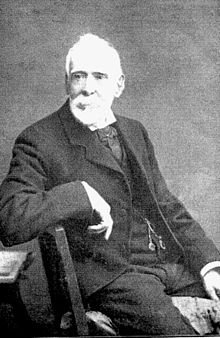
Timothy Daniel Sullivan
The original song, written only three years before “God Save Ireland,” struck a chord with Union POWs. The fact that it made it to Ireland in just three years may seem surprising, but a closer look into the relationship between the United States and Ireland at this time helps to explain this rapid diffusion.
The Great Famine had caused massive migrations of the Irish to the US between 1845 and 1852. By the time the American Civil War began in 1861, there were large numbers of Irish Americans fighting for both the Union and the Confederacy. Armed with this knowledge, it is easy to see how “Tramp! Tramp! Tramp!” became an inspiration for Sullivan when he wrote “God Save Ireland.”
“God Save Ireland” in a song written by T.D. Sullivan which served as an unofficial national anthem for Irish Nationalists from the time of its writing until the tumultuous decade of the 1910s. The original lyrics are below.
God Save Ireland
Original Lyrics by T.D. Sullivan
High upon the gallows tree swung the noble-hearted three.
By the vengeful tyrant stricken in their bloom;
But they met him face to face, with the courage of their race,
And they went with souls undaunted to their doom.
“God save Ireland!” said the heroes;
“God save Ireland” said they all.
Whether on the scaffold high
Or the battlefield we die,
Oh, what matter when for Erin dear we fall!
Girt around with cruel foes, still their courage proudly rose,
For they thought of hearts that loved them far and near;
Of the millions true and brave o’er the ocean’s swelling wave,
And the friends in holy Ireland ever dear.
“God save Ireland!” said the heroes;
“God save Ireland” said they all.
Whether on the scaffold high
Or the battlefield we die,
Oh, what matter when for Erin dear we fall!
Climbed they up the rugged stair, rang their voices out in prayer,
Then with England’s fatal cord around them cast,
Close beside the gallows tree kissed like brothers lovingly,
True to home and faith and freedom to the last.
“God save Ireland!” said the heroes;
“God save Ireland” said they all.
Whether on the scaffold high
Or the battlefield we die,
Oh, what matter when for Erin dear we fall!
Never till the latest day shall the memory pass away,
Of the gallant lives thus given for our land;
But on the cause must go, amidst joy and weal and woe,
Till we make our Isle a nation free and grand.
“God save Ireland!” said the heroes;
“God save Ireland” said they all.
Whether on the scaffold high
Or the battlefield we die,
Oh, what matter when for Erin dear we fall!
The song has a fascinating history associated with it; it is sung to the tune of a U.S. civil war song, and after the Manchester Outrages it was re-purposed by the Fenians as a national anthem. It was famously sung by participants of the Easter 1916 rising, and is still widely known today.
“The Troubles” in Ireland was a period of time in which a civil rights movement for those of the Catholic faith resulted in a sustained system of violence. Both the state and people who formed alliances against the state used war tactics in a cycle against one another. As Catholic people continued to lack basic constitutional rights such as equal representation in government, Protestants and the British government periodically ignored requests for such rights. This occurred particularly in Northern Ireland, as John Conroy made evident in Belfast Diary, when he lived in a Catholic neighborhood for a number of years to gain an “unbiased” perspective on the issue. The escalation of the situation from 1969, when it was a civil rights movement, to 1979, when “war was the way of life” according to John Conroy, can be attributed to the fact that, when treated as criminal, inferior people, eventually the group will become just that.
Civil rights groups formed to raise awareness of the situation Irish Catholics were facing in the 1960s in Ireland. They introduced pamphlets detailing the discrepancies between rights afforded to Irish Protestants and Catholics. Issues such as job discrimination, police brutality, the establishment of ghettoes for Catholics, and separation for education were outlined and described. However, similar to the situation with the hunger strikes, the British government continued to ignore the Catholics’ pleas for basic rights. As the situation continued, police brutality worsened, and violence became the way of life in Northern Ireland.
Catholic and Protestant children did not always want to throw stones at one another for fun. Teenagers do not typically wish to have their kneecaps shot to simultaneously make money and prove oneself to one’s friends. During The Troubles, that was the way of life. People like John Conroy’s landlady, Mrs. Barber, who were born into the situation, did not wish to move out of it because it was all they had ever known. Because they were forced into ghettoes, jobless, and without hope of governmental help without adequate representation, groups like the IRA formed. Suddenly, the oppressed had a means of fighting back, in equally horrific ways as their oppressors. It was terrorism as a means of the “powerless gaining power” according to the romantic sublime.
The campaign for social justice pamphlet and Belfast Diary describe two consecutive decades in Northern Ireland throughout which a civil rights movement turned into much more than that. The movement became a condition in which open violence was normal and continuous, from beatings to bombings in order to sustain the oppression of the Catholic people and the Catholic attempt to fight back. Terrorism, in its definition as a social problem, erupted as the powerless Catholics struggled to gain any power from their intimidators. The Troubles marked a time in which the state openly tortured and intimidated and the provos terrorized them in return, all as their way of life. What began as an attempt to gain basic human rights for those of the Catholic faith became a decades long war, one in which people were born into and died within. The Irish people, like so many others, have created a perpetual cycle for themselves in which Protestants treat Catholics like criminals, and so Catholics respond that way.
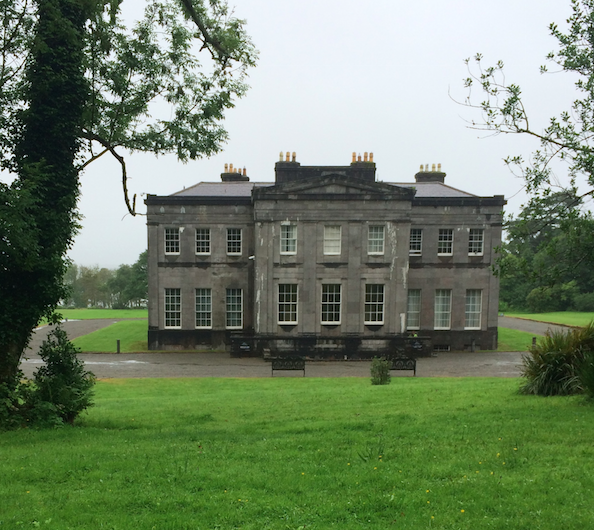
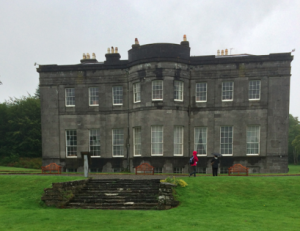
Lissadell House is a “Big House” built by the Ascendancy in the 1830s after a mysterious demolition of the old property on the Lissadell land. At this time, Sir Robert Gore-Booth (4th Bt) commissioned Francis Goodwin as architect to build the Georgian mansion on the 30,000 acres of estate. For an equivalent of approximately one hundred million euros today, Gore-Booth had one of the most impressive estates in Ireland and England of the time. According to records held by the United Kingdom (not Ireland, which is interesting) the neoclassical style, which could be viewed as imposing, was a welcome addition to the view matching the scenery nicely.
Considering their ownership of so much land, the Gore-Booths were responsible for multitudes of tenants during the Great Famine. While on the tours the guides will tell you how very kindly the owners handled their tenants, Sir Robert Gore-Booth did have a reputation for hiring his own “coffin ship” for his tenants. According to the archives from the Public Record Office of Northern Ireland, he has over three volumes of records of tenants, and numerous miscellaneous letters on sending “dispossessed tenants of Gore-Booth farms of Ballygilgan” to America. There are also numerous volumes on the relief programs the house held, including the soup kitchen where Caroline Gore-Booth set up and, according to the modern owners, often served “up to 200 gallons per day”.
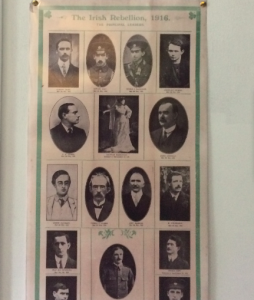
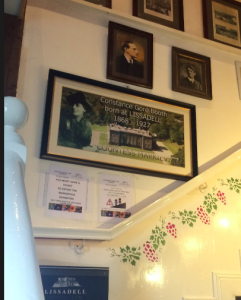
Sir Robert’s son Henry gave birth to four children, two of which were Constance and Eva, who are mentioned in Yeats’ poem. Constance, the oldest, was largely notable for her political involvement. Married to Count Markievicz of Ukraine, she was able to rise in politics from painter and an Irish nationalist. Constance became a leader in the 1916 Rising, the first female minister in the world (in the first Dail), and a founding member of Fianna Fail.
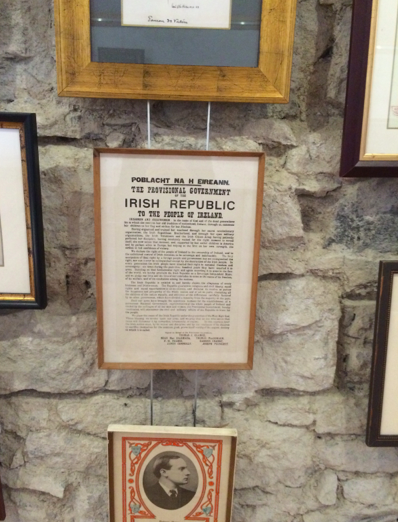
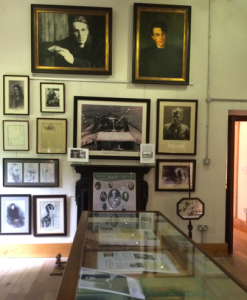
Writings on the Irish Republic from the Provisional Government on Display at Lissadell House“The Irish Rebellion, 1916” Photographs of the leaders of the 1916 rising with Constance Markievicz in the middle of the second row On display in the Lissadell Tea Rooms
The entrance to the Con Markievicz exhibit in Lissadell
Eva Gore-Booth, the other subject of Yeats’ poem “In Memory of Eva Gore-Booth and Con Markievicz” was a renowned suffragette. Her extreme involvement in a cause that sought to increase women’s rights in matters outside of the aesthetic realm did not particularly please her friend W.B. Yeats as he demonstrated in his poem.
Their third sibling, Josslyn, was the next heir to the estate. Under his rule, he maintained even better relations with tenants, even selling 28,000 acres of the land fairly (according to sources now) under the 1903 Whyndam Land Act. Josslyn’s generation marked the last before the decline of the house that lasted through the 1990s, in which only three rooms and the kitchen were occupied. The rest of the home and grounds remained in disarray until the present owners bought the estate in 2003.
Yeats in Lissadell
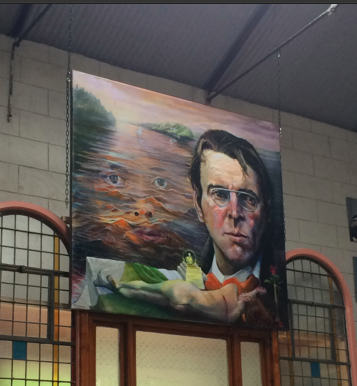
W.B. Yeats, who spent much of his childhood in Sligo, had attended horse racing and cricket matches at Lissadell House. Later on, an established poet and fervent admirer of the aristocracy, Yeats visited Lissadell House when Eva Gore-Booth and Con Markievicz resided there in 1894 and 1895. Dr. Joseph Valente, a lecturer at the Yeats Summer School, pointed out following the tour that Yeats slept above the portico when he visited the home. This means that although Yeats revered the aristocracy, and had moved up enough in the social classes to visit Lissadell House, he was still not high enough to stay within the actual house.
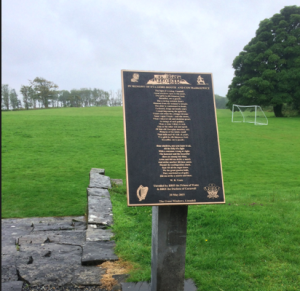
In 1927, he published the poem “In Memory of Eva Gore-Booth and Con Markievicz” which is displayed in numerous locations on the Lissadell property currently. However, to those who are familiar with the poem, as were the Yeats scholars with whom I toured the home, this is a bit puzzling. The poem does not portray either woman in a way in which one would think the owners would be proud of them.
While many aspects of this poem can be interpreted differently, the fact that Eva Gore-Booth and Con Markievicz are portrayed as beautiful aristocrats who did something wrong by placing value in something other than their wealth and beauty, is widely accepted.
In this poem, Yeats aestheticizes both Lissadell House and the girls, but in this he makes the point that the women grow older and politicized, thus losing their beauty. However, the house, as art maintained its aesthetic value which he portrayed both in the first two lines, when he did not use a verb with tense, giving an eternal image of the house. The speaker also says in lines 14-16 in the present tense, that “many a time I think to seek one or the other out and speak of that old Georgian mansion” despite the fact that at the present time the girls were dead. This emphasizes the fact that the girls could not last, but the house, as art–a purely aesthetic object–is eternal. Furthermore, in lines 12 and 13, it is made clear that Eva was made “old and skeleton-gaunt” because of her politics. That is, if she had only placed value in herself aesthetically, she would still be beautiful. In this case, the speaker works against himself. As he himself states, “the innocent and the beautiful have no enemy but time” (24-25). Time would go by whether Eva only dressed for tea and walked the garden, or fought for political causes she believed in, and lose her beauty in either process if time were indeed her only enemy.
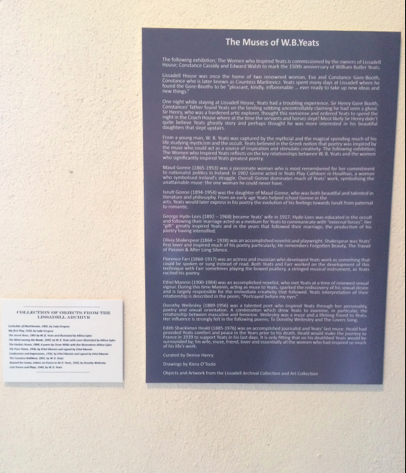
The WB Yeats exhibit in the stables of the houseThe entrance to the Muses of Yeats museum included the works of Oscar Wilde, Ezra Pound, and others
Modern Controversy
In 2003 Constance Cassidy and Eddie Walsh purchased the estate from Josslyn Gore-Booth reportedly for 3.75 million euros and have spent over 9 million euro since they purchased the home for their family of nine. The private purchase was news in itself, as Josslyn spoke on the record about how he would be “interested in the state buying it” and using it as a museum to its rich history. However, Cassidy and Walsh have restored it beautifully and have opened the basement and ground floor as a museum for the public while they live in the upper floors as a family.
However, there have been issues with litigation between the Cassidy/Walsh’s and Sligo County since 2008 over right of way through the property. There are four roadways that run through the property which, according to Sligo townspeople were used as public roads when the Gore-Booths owned the estate. However, according to the Cassidy/Walsh’s land agreement, they believed they owned the land and shut the gates, blocking the path of the public. They did so, reportedly, to protect the safety of their seven children who live in the home with them.
The situation resulted in litigation that resulted in a court ruling that the four access roads should remain public.In 2013 the Supreme Court ruled that “rights of way claimed by the local authority do not exist, in particular parking and right of way in front of the house” (“Family tell of relief after winning battle of Lissadell House rights of way”).
In 2014 however the home was able to reopen the basement and ground floors as museum space. The grounds are now open to visitors, yet pictures remain all over the museum portion of the home of the Cassidy/Walsh children.It also stands as a testament of Irish history, with the last Gore-Booths expressing that they wished the state would buy the home. However, as a Big House of Irish history the house stood for the wealth and oppression of the British in Ireland. Fittingly, there are pictures of the homeowners with multiple members of the British Royal family on display throughout the museum of Lissadell.
It is evident this is home to a family in certain regards, however. The backyard facing the lake has two football nets, and the pictures of the family throughout are simultaneously welcoming and also a bit of a threatening reminder. Nonetheless, the family is reported to have spent over nine million euro on renovation of the estate, and must bring in a good deal of revenue for the surrounding area of County Sligo.
Despite the controversy of the home, it undoubtedly provided inspiration for artists like both WB and Jack Yeats. Other extraordinary political leaders like Constance and Eva grew up there and were able to flourish to impact thecountry of Ireland in numerous ways.
Lissadell House view from backyard
Works Cited
Cassidy, Constance, and Eddie Walsh. “LISSADELL HOUSE & GARDENS.” Lissadell House and Gardens Sligo. Lissadell House, n.d. Web. 21 Aug. 2015.
“Introduction Lissadell Papers.” (n.d.): 3-46. Public Record Office of Northern Ireland. Crown Copyright, Nov. 2007. Web. 20 Aug. 2015.
“Family Tell of Relief after Winning Battle over Lissadell House Rights of Way.” (Irish) Independent [Dublin] 11 Nov. 2013: n. pag.
McGowan, Joe. “Lissadell House, Coffin Ships…” Sligoheritage.com. Joe McGowan, 2008. Web. 21 Aug. 2015. <http://www.sligoheritage.com/archpomano.htm>.
Siggins, Lorna. “Lissadell House in Sligo Set to Reopen to Public.” Editorial. The Irish Times [Dublin] 15 June 2014: n. pag. The Irish Times. 15 June 2014. Web. 18 Aug. 2015.
The Anglo-Irish Treaty and the Constitution of Ireland that followed restricted the rights and freedom of the Irish people while they simultaneously attempted to reconcile the abuse the country had endured in its long history of conflict and uncertain ruling. These documents established physical and figurative borders and boundaries within the country of Ireland in a paradoxical effort to both separate and unify the people. When the contents of their new governing document, the Constitution of Ireland, were made public, the Irish population would recognize the potential for a similar kind of national instability that had already been encountered in the Anglo-Irish Treaty sixteen years previous to the formation of the Constitution.
Much of the Anglo-Irish Treaty indicates a desire for a smooth transition away from British interference in Ireland, while at the same time, measures were taken to ensure Ireland was not completely free from British presence. The British successfully managed to maintain connections with Ireland while they also established a boundary of separation between them and the people of Ireland. In 1937, sixteen years after the enactment of the Anglo-Irish Treaty, the Constitution of Ireland was created. The document established the rights and laws of the people of the Republic of Ireland. The Constitution attempted to claim from its beginning that “The national territory consists of the whole island of Ireland,” before an amendment was made decades later to delete this particular passage. The Constitution of Ireland was meant to unify and celebrate the people of Ireland, but instead, it tried to control them and the (legally separate) nation of Northern Ireland and perpetuated national instability.
Both the Treaty and the Constitution failed in their goals of easing the tensions within the country. While the new legislation may have been met with some success, it also caused new issues and questions that would be scrutinized and spoken out against for the coming decades. Ireland was marked by many centuries of struggle for survival and proved its incredible capacity to endure long years of suffering, so it may have grown used to unstable grounds and little victories won over bit by bit. Ireland had a great task to take on once Great Britain withdrew much of its political hold with the enactment of the Anglo-Irish Treaty, and Ireland got off to a shaky start. From the beginning, the Republic of Ireland was faced with the majority of its population’s desire to unify the island of Ireland, but it was also presented with the problem of what it should do with Northern Ireland, and more importantly, what it could do. Unfortunately, the Treaty and the Constitution proved incapable of resolving Ireland’s history of conflict and disunity at their creation, and instead successfully caused a great deal of upheaval and unrest in the country. Many Irish citizens may have been in support of keeping the island together for the geographical sense it made, but borders and boundaries are hardly ever tied up so neatly. Certainly, the borders separating Northern Ireland from the Republic of Ireland seem almost arbitrarily drawn, however, those very same borders were the source of a great deal of conflict within Ireland, as well were the wider borders between Ireland and Great Britain. The disruption caused by the conflict of how to separate groups of people still survives today, and is memorialized within the invisible boundaries drawn between the different nations.
Derry has an air about it of hard-won peace and respectful solemnity. The Bogside Artists may have contributed to the atmosphere of the city, or the art they created may reflect the sentiments of the people. Either way, the product of the politically-charged atmosphere is a great deal of politically-charged art and graffiti throughout the city of Derry. The Bogside Artists made a tremendous effort to overcome the pain of the troubles in Northern Ireland and the attempts of many to keep the tensions alive, while still commemorating those who were lost. The artists and their murals live on to this day, as well does a new tradition of political awareness demonstrated and passed along through official and unofficial artwork.
To navigate the art and graffiti of Derry, follow these links:
Cashman, Ray. “Visions of Irish Nationalism.” Journal of Folklore Research: An International Journal of Folklore and Ethnomusicology 45.3 (2008): 361-81. Web.
Joseph, Anthony C. The People’s Gallery: The Bogside Artists. 2001. Print.
Graffiti is so often overlooked because it lacks the refinement that is usually more present in sanctioned art. Nevertheless, graffiti is often just as politically charged as the murals it is painted next to. While exploring Derry, I discovered the city had perhaps just as much graffiti in it as any other city, but the vandalism and messages I came across had about it an unusually high percentage of political awareness and appeals for activism. Usually, graffiti is a quick tag of the graffiti artist’s name or pseudonym, but in Derry, much of the graffiti was composed of the IRA’s letters, calls for social justice, and messages lashing out at particular groups.
What does it all mean?
Street art is a representation of the people who live within the streets, and it reflects the zeitgeist of the community. To see how closely tied together art and the sentiments of the people of Derry are, one need only walk through the streets and observe the murals and graffiti that cover it. In an analysis of Irish nationalism, Ray Cashman explains that “Decoding this urban visual scene, punctuated and anchored by murals, benefits from local knowledge and an appreciation of visual semiotics,” (Cashman). The pain and suffering Derry endured for decades is memorialized through the art painted into it, and that art contributes to a sense of responsibility in the people who walk the city’s streets to respect its history and to be proactive in the present to keep history from repeating itself.
Upon crossing the bridge into the Protestant section of Derry, one would come across more murals, but of a very different nature than those created by the Bogside Artists. The artwork in this section of Derry is filled with British propaganda, and for many Irish Catholics, it is representative of many long years the they endured in conflict with the Protestants. While walking through the neighborhood, I could not imagine why this frankly terrifying atmosphere broadcasted by the artwork and decoration was allowed to last. Many of the murals have fallen into disrepair since their creation, so no one was making any effort to restore them in the same way the Bogside Artists continue to restore their murals on the Bogside.
The murals in this neighborhood are comparable to the work of the Bogside Artists in that they, too, serves as a reminder of the hard times in Northern Ireland. These murals, however, lack the air of respect and solemnity the Bogside Artists worked so painstakingly in their own art to achieve. The art over the bridge in this section of Derry recall the violence and polarization the troubles wrought without reconciling with them.