“Wasted Life”

In their song, “Wasted Life,” Stiff Little Fingers explore the heritage of violence that they find themselves confronted with living through The Troubles. The song title itself, “Wasted Life,” is aimed at individuals who choose to use violence to achieve their ideological ends. The first lines in the song, “I could be a solider, Go out there and fight to save this land, I could be a peoples soldier, Paramilitary gun in hand,” indicates a sense of mockery, again aimed at violent ideologues fighting to “save the land.” Here the band clearly pushes back against the violent history of their homeland as well – opposing the views of the first verse character of Lamar’s “m.A.A.d. City“.

Protestant youth next to a Unionist paramilitary mural – note the apparent chaos in the background and how at ease the youth look surrounded by violence.

The issues of heritage and violence are mixed in “Wasted Life” as seen in the chorus – “They wanna waste my time, They wanna waste my life, and They’ve stolen it away.” Emphasis is added on ‘They.” A heritage of violence fostered by The Troubles is caused by the extremely divided sectarian population of Northern Ireland. Being approached by paramilitary groups as a form of recruitment would not be something unheard of for the young band members of Stiff Little Fingers. Band members interviewed for Kicking Up a Racket and discussed threats of violence from paramilitary groups for singing about and exposing their fallacies – “There’s no doubting that such encounters with the Provisional IRA and the Loyalist paramilitaries were, potentially, highly dangerous.”

The last stanza in Wasted Life also brings to focus the cyclical heritage of  violence seen not only in Lamar’s “Money Trees” but the first verse of “Sing About Me” as well. “Still they come up to me, With a different name but the same old face, I can see a connection, With another time and a different place.” This is an allusion to the constantly changing and fragmenting of paramilitary groups. The IRA is the best example of this, splitting multiple times in its history, with each new split claiming to have the correct ideological standing.

[If you would like to refresh your interactive experience please pinback to the songs.]

“Alternative Ulster”


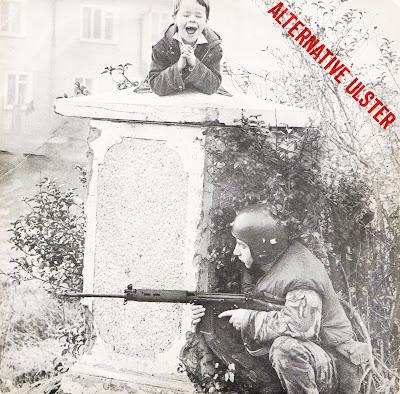
Alternative Ulster” is the signature track off of Inflammable Material, carrying enough cultural influence to have a Belfast based music magazine name after it. Similar to other songs on Inflammable Material, “Alternative Ulster” deals with identity issues that arise from living in an oppressive and sectarian society, as well as authenticity issues that come from living in a violent and oppressive situation.

‘Alternative Ulster’ Single Cover

The last stanza addresses identity in the all-encompassing ideological stand off of Northern Ireland. “They say they’re a part of you, But that’s not true you know/They say they’ve got control of you, And that’s a lie you know/ They say you will never be free.” This is a call to resist any possible inherited obligation to engage with The Troubles in an extremist way. The chorus also supports individual choice, offering alternatives for Ulster as being within reach and also rejecting ubiquitous reactionary militarism: “An Alternative Ulster, Grab it change it it’s yours/Get an Alternative Ulster, Ignore the bores and their laws/ Get an alternative Ulster, Be an anti-security force.” Ignoring “the bores and their laws” is referential to sectarian legislature, but also a nihilistic punk genre motif as well.

“Alternative Ulster” also deals with issues of authenticity while living in Northern Ireland. The first stanza includes some lines concerned with a lack of authentic existence; due to not belonging either entirely to Ireland or England. “Nothin’ for us in Belfast, the Pound’s so old it’s a pity/OK, there’s the trident in Bangor, Then we walk back to the city.” Referring to the Pound as old indicates a lack of necessity for England for the people in Ulster. This brings to light interactions between England and Northern Ireland in the early 20th century, where England viewed Unionist Northern Ireland as “a particularly tiresome problem, apt to be a nuisance.”* Walking to Bangor is also mentioned, and this is referential to the wealthiest town in Northern Ireland, which even during The Troubles was an idealistic Irish tourist town. This ideal of Ireland is not however sustainable and the realities of sectarian Ulster must be returned to. By rejecting both ties to a “traditional Ireland” and England, Stiff Little Fingers vie for authenticity in a unique created space.

Despite the institutionalized violence and oppression present in Northern Ireland, it is not condoned in any manner: “Take a look where you’re livin’, You got the Army on your street, and the RUC dog of repression, Is barking at your feet.” Ulster is defended as being capable of authentic experience. The chorus also states, “Alter your native Ulster, Alter your native land.” While it may not seem important, the usage of “your native” calls for genuine pride in Ulster, and alludes to ideas on Lamar’s “Compton,” standing out on an album filled with mostly scathing mockery of a difficult situation.

[If you would like to refresh your interactive experience please pinback to the songs.]


*McVea and McKittrick (28)

“Compton”

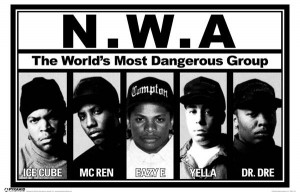
Kendrick Lamar’s song “Compton” is a shout out to west coast hip-hop heritage and suggests a sense authenticity that comes from creating an identity in an oppressive situation. Authenticity in Lamar’s music comes from establishing ties firmly with traditional hip-hop sound, which is not only heard on “Compton,” but also from identifying with grandfather figures from the 1980s such as N.W.A. and their massively influential first album titled, “Straight Outta Compton.” Dr. Dre is featured on the track and alternates verses with Lamar.

nwa
An image of the rap group that introduced Compton and its troubles to the American public.

Identity and authenticity are both derived from the city of Compton, despite the excessive violence and crime. Lamar makes his adoration of Compton clear with the song hook, which repeats throughout the song, “Compton, Compton, Ain’t no city quite like mine.” Although violence is neither condoned nor embraced it is assimilated into one’s identity by merely living in Compton. Lamar takes pride in being from, “the murder cap,” and invites the listener to know where he comes from: “So come and visit, the tires screeching, Ambulance, policeman/Won’t you spend a weekend on Rosecrans nigga?” This invitation is aware of the violent nature and reputation of Compton, but indicates something deeper.

Most interestingly in “Compton” is how the violent and oppressive conditions in Compton seem to foster an area for musical out put. Lamar is aware of the unique space his music creates and exists in, but also how it can be powerful – “It’s controversy and hate, Harsh realities we in, Made our music translate.” Lamar also mentions the power of a new record can have, “I’m sure it’s bigger than your religion, perfected by niggas that manifested music to live in.” It is clear that Lamar takes pride in his music, being an alternative voice for the disenfranchised.

[If you would like to refresh your interactive experience please pinback to the songs.]

“Sing About Me, I’m Dying of Thirst”

“Sing About Me, I’m Dying of Thirst” is the 10th track off of Lamar’s album. The track runs just over 12 minutes, and accordingly covers a lot of themes. Three different voices and characters  are offered during the narrative, each verse containing different perspectives of Compton and cover four distinct themes. The first deals with violence and the connection with identity, the second with a female voice and through that different views on masculinity, and the third offers a stream-of-conscious view of an isolated character, lost in his own thoughts. Ending the track is a skit, a throwback to classic hip-hop albums, a way for the artist to give a shout-out to the heritage of hip-hop.

The first character recounts the death of his little brother the previous night. The narrator gets his revenge – “A demon glued to my back whispering, ‘Get em’ / I got em, and I ain’t give a fuck.” The implied violent retaliation is more menacing than a lyric detailing the revenge killing. This depiction of violence seems a bit over the top at first but later the narrator admits “I’m proud and well devoted / This piru shit been in me forever / So forever I’mma push it.” Retaliatory violence is nothing new to this character; its a part of him, he takes pride in it and when his family became involved his reaction was one that he was comfortable with. Violence is how the character defines himself and his situation. Violence as a defining factor of life comes forward in Stiff Little Fingers’ “Law and Order“ as well, but where the Belfast group deals with the brutality of the law regularly, Lamar’s character adheres to a street law that seems to be even more brutal. Stiff Little Fingers just gets beaten by those that are supposed to protect them, while the first voice of “Sing About Me” ends up being presumably shot dead in retaliation for the revenge killing he participated in, creating a cycle of death. His identity was defined by violence, and now it has been snuffed out by violence as well.

This idea of a perpetuation of death is echoed in Stiff Little Fingers’ “No More of That” as well, with the final lines remaining poignant to Lamars’s story as well:

The man who pulls the trigger’s not to blame

He’s only playing their deadly game

And he knows he just can’t win

Or someone else will pull the trigger on him.

These lyrics could have easily followed the final line of Lamar’s first verse, operating as an epitaph.

The second voice is a female character, one whose interactions with the males in her life critique the views on traditional masculinity. She explicitly talks about the men her life paying her for sex, cheating on their wives with her in their cars, passing her around to friends and family members. Her narrative certainly does not paint her in a positive light, but whereas her actions stem from desperation and necessity, the men are all driven by lust. With this verse comes Lamar’s critique on masculinity, showcasing exploitation. Here men are not supporters or stand-up guys but users and abusers. Further critique comes in the form of “her’”reference to the 2-Pac track “Brenda’s Got a Baby” in which a young preteen girl has a child. Her father “was a junkie” who was not there for her and the father of this child is not around. Lamar uses this 90s title drop to show that there is a history of this exploitation, that this form of immoral male behavior has been present in previous generations too, a heritage of warped masculinity that continues.

The third voice is a character talking/thinking to himself, introspecting. He is alone with his thoughts, and the monologue is at times worrying – “I suffer a lot / And every day the glass mirror get tougher to watch / I tie my stomach in knots / And I’m sure not why I’m infatuated with death / My imagination is surely an aggravation of threats.” These thoughts of uncertainty portray an aloneness and isolation reminiscent of lines from Stiff Little Fingers’ “Here We Are Nowhere” – “Here we are nowhere maybe that’s where we belong.” Identity is rooted in isolation here, a single figure contemplating his worth and his meaning. This uncertainty and unhappiness portrayed here are really a reflection of all adolescence, whether it be Cal in Bernard MacLaverty’s novel  or Lamar in his decision to portray his heritage as “my angry adolescence divided.”

The line on an “infatuation with death” echoed loudly when we read it, immediately brings us to Stiff Little Fingers’ “Barbed Wire Love.” While the most prevalent theme of this track is the relationship between love and pain, this particular line from Lamar’s song brings a nihilistic worry that the themes of isolation do not quite reach. The characters in “Here We Are Nowhere” and Cal are certainly alienated but Lamar’s character in this final verse seems to be a step further in the wrong direction.

For all characters, identity is struggle: a struggle to find a balance of violence, a struggle against misguided sense of masculinity, a struggle to end a perpetuation of heritage, or a struggle to use alone time to think proactively and not get caught up in everything and lose faith. The ending skit shuns the perpetuation of the past; most hip-hop skits are based in comedy but here Lamar uses a skit to further his concept of the struggle for identity, tying together the themes explored in the previous verses to close a bleak take on identity across all types o f individuals.

[If you would like to refresh your interactive experience please pinback to the songs.]

“Here We are Nowhere”

Stiff Little Fingers’ track “Here We are Nowhere” is the shortest track on “Inflammable Material.” The song captures the boredom experienced by Northern Irish youths. It is a quick and succinct track whose rapid-fire lyrics ask for a third space to alleviate Northern Irish tedium. Stiff Little Fingers’ influence come from their ambiguity. The lyrics refer to a generalized youth experiencing Northern Ireland’s tedium, not drawing on the differences between Catholics and Protestants. Bandleader Jake Burns shouts, “Is it a crime to be young / Cause’ every time we have some fun / They put us down and tell us we’re wrong / Every time they sing the same old song / Here we are nowhere that’s where we belong.” Thus, Northern Ireland’s conditions–most notably its innocuous and authoritative structures–is a consequence experienced by all Northern Irishmen, regardless of religion or political affiliation.

Grappling boredom is a significant theme in punk music. Several academics frame punk as a response to post-modern capitalism that globalized markets and over saturated individuals with media and technological overhauls. The post-modern world transformed domestic space and related it to the transnational sphere. This expansion and over saturation of information caused individuals to lose the ability to think freely and creatively. Burns feels these effects in Northern Ireland when he shouts “Nothing on the telly, there is no late-night show / No shows in town, there is no place to go.” Stiff Little Fingers and punk demand to find a new  space and form of entertainment that can excite the Northern Irish experience. Therefore, not only was it violence that effected how Northern Irishmen functioned, but the overall structure of the post-modern world. Violence may have been a normal function of Northern Irish living, but outside of violence, in one’s daily routine, they still felt a hollowness and lonesomeness that was carved by post-modern living. This consequence was experienced by all Northern Irishmen and expressed a universality in the way Stiff Little Fingers understood Northern Irish life and audiences.

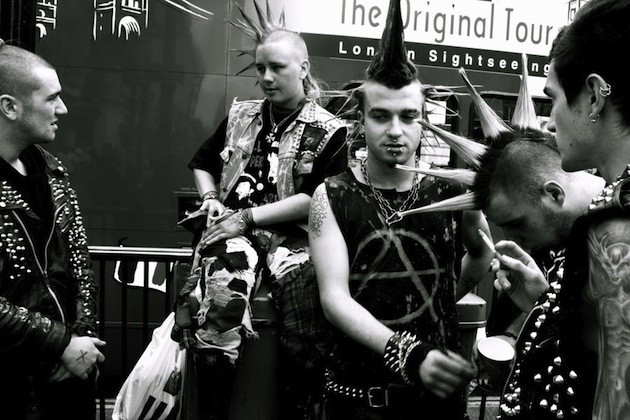
PUNK1
An image of some punk rockers outside of a concert displaying their piercings and eccentric hair-stylings.

Stiff Little Fingers, like Lamar, demanded an authenticity and a community that challenged the structures that deprived individuality. While hip-hop music developed its own sector of African-American culture, using specific references and sampling black artists, Stiff Little Fingers and punk examined the world with a much larger scope. The consequences of African-American living were concentrated and targeted specifically on black individuals. However, boredom was a result of much larger structures at work that effected all individuals, independent of race, ethnicity, or social community. Punk, therefore, sarcastically and sometimes nihilistically re-appropriated the spaces and bodies they believed post-modern living repressed. Hence, the piercings, tattoos, dress, and hairstyling associated with the punk aesthetic. These new bodies and new spaces–spaces that held punk shows and contained audiences’ bodies–were a visceral reminder to individuals that they have the agency to alter their bodies and their spaces. Punk was a realization and a hyperbolic response to reclaim the structures that global capitalism altered. Songs like “Here We are Nowhere” articulated this idea using quick, visceral shouts, unconsciously reminding peoples they’re capable of making their voices heard, and implored individuals to reexamine their spaces.

[If you would like to refresh your interactive experience please pinback to the songs.]

‘The Two Sisters’

‘The Two Sisters’

Dennis Corcoran

This play, written by St. Louis playwright Dennis Corcoran, is set in 1980 in the women’s prison at Armagh, Northern Ireland, and addresses the heroism and brutishness that can arise in the face of political and religious conflicts.

Historical Background on the play:

In February, 1980, IRA inmates in the women’s prison at Armagh joined this “dirty protest.”  In Ireland and in the Catholic Church the feeling was that women didn’t belong in prison anyway.  They were “special”—assigned by God to nurture children and support husbands.  The fact that these were women (who were smearing not only excrement but also menstrual blood on their cell walls) raised a wide public outrage.  There were marching demonstrations by Catholics, Protestants, feminists—really everyone concerned with human rights—against these deplorable conditions.

The play itself:

http://youtu.be/tf7ACXCEg4k

We see five prison cells—two left, two right and one up center.  Fragmentary concrete walls with exposed re-enforcement bars convey the grim reality in which these women are forced to live.  Guards’ desks flank the stage, left and right.  Above the center cell is a large screen, framed by graceful flourishes, on which striking period images are projected.

We meet five prisoners:  Άine, Siobhán and Maureen arein the IRA.  Janice is a Protestant jailed for murder and she’s raging fierce.  Emma is a battered wife who killed her husband;  she’s mute, depressed, suicidal.  The two female guards are most definitely “good cop” and “very bad cop”.  And then there is the dancer, who rises from beneath the stage to introduce the evening with an interpretive modern “Dance of War.”

The play consists of eighteen brief scenes in which we see the growing conflict and violence between the inmates and the authorities.  There are occasional “voice-over” monologues between scenes;  these are in graceful rhymed verse.  The forbidden Gaelic drifts through the dialogue—most notably in a common prayer.  There is much anguish—and much beauty in this play.

Reactions to the Play: (Steve Callahan) 

Author Dennis Corcoran does little to mask his bias toward the Catholic cause.  And why should he?  The Protestant brutality is presented vividly.  Yet, though it can be shocking, it is hardly real drama to simply show bad people doing bad things;  far better if we can see something of ourselves in these bad people—our feelings, our fears, our motivations. Most of the scenes are of unrelieved suffering, with hatred and vituperation hurled back and forth between the inmates and the guards.  Once, indeed, Siobhán does a bit of stand-up comedy for her friends, parodying her own arrival at the prison as if she’d arrived at a grand hotel.  But she falls a tiny bit short of the pace and punch of a true stand-up comic.  So for the most part we see nothing but misery, misery, misery. There are many beautiful things here, but I felt something was missing:  I didn’t find a real arc of plot.

Moreover, I sensed more than one voice at play here.  I don’t know if this was the case, but there seemed to be hints that Corcoran’s play had been subjected to “workshopping”.  Did each actress contribute to her scenes and monologue?  Did the presence of dance talent persuade the author to include dance?  If so perhaps these elements were not quite perfectly integrated into the play.  For me it lacked an overall coherence. But it is nevertheless a work of considerable strength and beauty, and a triumph for all involved.


Internal Notes for LA connection to Northern Ireland Policing

Foreword: I’m posting this because I’m still working on articulating my own posts, and as a result, they’re a bit sparse on information. These are my own notes I have on my google drive account, and I’m currently trying to organize them into meaningful content. Should anyone care to read them, “Norn Iron” is shorthand for “Northern Ireland/Northern Irish”.

Breakdown of broad similarities between LA riots and Bloody Sunday/ensuing troubles

Long-term mutual hatred between minority population and the po-po
Strong socio-economic divide between minorities (poor and unemployed catholics/blacks and hispanics) versus well-to-do-majority (Prods in norn iron, Whites in L.A. and to a lesser degree Koreans)
Police made up of a completely different, richer, more socially-dominant demographic than the people they policed. Also, lack of good will between the two groups and long history of gratuitous violence and intimidation. (prods policing catholics/mostly white folks policing blacks and hispanics in LA). Source for Norn Iron aspect is “The Plain truth”.
Hostilities peaked at the fever pitch of an economic downturn that disproportionately hit minorities (Catholics around Bloody Sunday/The Troubles in general, Blacks/Hispanics in 1992) (The plain truth/Chris commission/[Especially for economic factors of buildup to 1992] “To rebuild is not enough”)
Here’s the main divergence: once riots and civil unrest break out, national troops are called in. In LA, this helped tremendously. In Norn Iron, this exacerbated the situation as there was a layer of unfamiliarity between the Brits and Northern Irish, especially Catholics. One thing immediately apparent was the healthy respect people in LA had for troops (http://fmso.leavenworth.army.mil/documents/rio.htm) versus the historically-rooted antagonism in Norn Iron, especially amongst republican actors who held an “invasion narrative” which condemned the UK army as an outside force. (MacStiofan interview, for starters)
In some broad sense, the impetus for both situations (LA riots/Norn Iron catholic protests in 1972) were police beating minorities (LAPD policy of beating the crap out of suspects epitomized by Rodney King vs. RUC mistreatment of Catholics epitomized by beating the piss out of them at peaceful rallies). (CHRISTOPHER COMMISSION)
“Additionally, a fierce culture of independence had been deeply ingrained within the department’s leadership, to the degree that its leaders routinely refused to plan and coordinate emergency response with other agencies: it was inconceivable that the LAPD would ever require outside assistance.”
(http://strategicstudiesinstitute.army.mil/pubs/parameters/Articles/97summer/schnau.htm)
RUC and LAPD see themselves as 1hunnit percent independent from their superseding military organization prior to joint operations (in one case, the British Army, in the other CANG/Federal National Guard).
Also, RUC/norn iron in general were fiercely independent, seeing England as a “fickle ally” (see p.119 of Belfast Diary)
One important discrepancy: Prod paramilitaries have no analogous bodies in LA (No White-Power militias in league with LAPD/National Guard/Federal government).
Maybe Koreans are a (very bad and loose) analogy?
Another: Brit troops, though initially welcomed as a “third sphere” force, may have been thought of by the republicans as being in the same governmental sphere as the RUC due to their “invasion” narrative (Frontline Kelly Interview). Contrast LA, where bloods, crips, hispanic gangs, and unaligned civilians all had respect for federal troops and/or state troops and/or state troops perceived as federal troops (LA Riots and Operation Rio).
Investigate: LAPD gave (???) some HUMINT to nat’l guard troops, and RUC gave similar to British Army troops. Investigate discrepancies in info given by RUC to Brit Army vs LAPD to Nat’l Guard
Important to note: JTF-LA was made up of 1st Marine Division, CANG, and Army 7th Infantry Division. Also, CANG was federalized. This is imperative to sealing the deal for analogies to Brit Army being called into Norn Iron
Crips/Bloods acted in a sophisticated manner befitting paramilitaries (http://fmso.leavenworth.army.mil/documents/rio.htm)
Some material on buildup to 1992 (http://www.usc.edu/libraries/archives/cityinstress/reb/i.htm)
Some material on LAPD 1992 aftermath (http://www.pbs.org/wgbh/pages/frontline/shows/lapd/later/decree.html)
Some material on RUC buildup (COMPTON REPORT; selections from Bloody Sunday and the Rule of Law in Northern Ireland).
Some material on RUC aftermath ()

late 60’s/early 70’s british reports on policing

Compton report
Inquiries into police brutality, five techniques, manifestations of policing in Norn Iron in general.

Morality in Law Enforcement: Chasing “Bad Guys” with the Los Angeles Police Department (Academic source; links pending)

page 802 contains indications that LAPD cops would often produce labels for everyone that made it easier to justify actions against them and/or portray said people as those who might act violently or adversely for no good rational reason. Also in this and the previous page, it’s established as rhetoric used in po-po training.

p.806: Policing is found in the overwhelming majority of cases to be ineffective in radically reducing crime rates of their jurisdictions.

“Christopher Commission”

p.34 and summaries: LAPD cops have 5-11% of po-po who either engage in excessive force or think it’s warranted when that’s clearly not the case. There were some other very startling and very usable figures preceding this, too.

p.49-54 are all GREAT for cops just randomly beating the shit out of suspects or administering vigilante “street justice”.

p.40 suggests that the 5% problem group is likely much larger than just that.

p.56: Really high instances of unwarranted shooting/beating after a dude’s apprehended. GODDAMN.

Racial makeup of LAPD pre-1992 was not representative of LA latino and black minorities according to pages 70/71 of the Christopher Commission until 1981. However, page 70 makes it clear that although by 1990 the LAPD was 37% minority (Latinos, blacks, asians, and basically the makeup of South Central LA other than whites), there was still a long-standing schism between the police department and its city.

Feminist Responses

Feminist responses toward the women in Armagh were polarized: either they felt they must support them as a women’s rights issue, or they felt that they could not support them due to their nationalist beliefs. The former group argued that the systematic male domination and sexual victimization within the prison bordered on human’s rights issues and could not be ignored. Many feminists took issue especially with the treatment of the prisoners during menstruation, during which they were inadequately supplied with sanitary products, and so smeared menstrual blood on the walls along with feces. One doctor commented on the effects of this kind of treatment:

“The most obvious stress results from the denial of adequate quantities of sanitary towels during menstruation. A ration of any sort is not only a cruel attempt at degradation.., but is physically inadequate” (Weinstein, 28).

In light of these concerns, along with sexual abuse, a faction of feminists took active support for the Armagh women. Indeed, the Armagh women themselves identified their issue as a feminist one,

“It is a feminist issue in so far as we are women, even though we are treated like criminals. It is a feminist issue when the network of this jail is completely geared to male domination. The governor, the assistant governor, and the doctor are all males. We are subject to physical and mental abuse from the male screws who patrol our wing daily, continually peeping into our cells. If this is not a feminist issue, then we feel that the word feminist needs to be redefined to suit these people who feel that “feminist” applies to a certain section of women rather than encompassing women everywhere, regardless of politically held views” (Weinstein, 26).

This identification with the feminist cause was also complicated by the prisoners’ claim that they weren’t separate from the men. The motive behind their protest was the same as the men’s, but they had been prevented from fully joining the men in their protest due to the gender inequalities within their own organization. Many people, like the faction of feminists supporting them, saw their protest as one against the degradation and mistreatment within the prison, less so as a political protest in the name of nationalism. Many republican women disagreed with this interpretation:

“People keep separating Armagh from H-Block. They shouldn’t be separated, they’re together, they are the same. The girls are not getting washed; there’s excreta smeared on the walls; no medical treatment; very little and almost inedible food (most of the girls live on bread most of the time); and harassment and beatings from the screws” (Weinstein, 25).

This reasoning is however, the main reason that many feminists refused to support the protesters. The nationalist goal of a “united Ireland,” which many republican women desired greater than their own freedom as women, many feminists did not agree with. To have a united republic would be to have the ideology of the republic, and necessarily of Catholicism, which was even more fiercely oppressive to women. One woman supported this stance:

“And that is why in no way am I looking for a united Ireland when, as things stand at the minute, all that would mean is more male domination” (Weinstein, 29).

For some women, the connection with the republican cause outweighed the issues of women’s rights at hand, and split the feminist community in their responses to the Armagh women. The schism between feminists was very clear, and those who supported the feminist caused criticized those who refused. Margaret D’arcy commented on this reaction:

“amazing how many women calling themselves feminists, closed their eyes, blocked up their ears, and ran to their political parties – Fine Gael, Sinn Fein the Workers’ Party, and the Irish Labour Party – seeking urgent reassurance in the old patriarchal priorities of women s needs” (Sullivan).

 Catholic Responses                    Republican Responses                    Feminist Responses

Republican Responses

Republican responses toward the Armagh protests were complicated and varied in their support for the women. Within the Republican tradition is deeply embedded the age-old idea of “Mother Ireland,” the fictitious symbolic woman who must occupy the domestic sphere or inspire her men to fight for their country to the death. Because of the prevalence of this tradition in Republican ideology, women were expected to play the role and if they strayed from it, were looked down upon. One republican woman describes the mentality:

“… it all boils down to this romantic “Mother Ireland” image. They like to depict Irish women as very staunch and behind their men…but only strong in so far as they’re ultimately supported by men. Not that they can support themselves, make decisions for themselves to have an affair or an “illegitimate” baby, get divorced, or decide to be a lesbian. These things don’t accord with what the pure image of an Irish woman is” (Weinstein, 21-2).

This ideology doesn’t leave room for real women to exist, and subsequently women are turned into symbols within this culture. Republican women existed as symbols in the eyes of their male counterparts up until the dirty protest shattered that image. The smeared menstrual blood on the walls of women’s cells is the antithesis to Mother Ireland, and casts the idea of “woman as nation” in a vastly different light. Though the IRA regarded the women’s participation in the dirty protest as a “step too far,” they ultimately needed to support their women publicly or risk fracturing (Weinstein, 21). This support for the women in both the dirty protest and the hunger strike was vastly gendered, and served merely to try to contextualize the protests within their traditional republican framework. One source noted the differences in media portrayal:

“The H-Block prisoners were portrayed as strong men with high morale-exhibiting a need to keep up the spirits of republican supporters. Republican News observed: ‘The men are possessed by a quiet confidence that what they are doing is right and eventually they will win. There can be little doubt that the morale of the screws will break before the morale of the blanket men.’ On the other hand, the republican media portrayed the protesting women as having been forced into the no-wash protest after they had been beaten by male warders and subsequently denied access to toilet and washing facilities. Rather than discussing their ‘unique and original’ offensive, the republican papers were filled with headlines like ‘Armagh women attacked,’ ‘Armagh beatings,’ and ‘Men squads beat women prisoners’” (22-3).

This rhetoric reinforces the oppressive Republican ideology towards women and reads their actions as something other than what they are. Not all republican reactions were the same, however. Some republican men, especially those protesting in Long Kesh, supported the women as comrades, and had an incredibly positive changed view about women following their time in prison. One man recounts this transition:

“We learnt to appreciate and even pay tribute to women’s participation in and contribution to the struggle. It took us much longer, however, to begin to critically examine our own roles and privileges as men, let alone the gendered division of power and labour in society, as well as in the republican movement. Our respect of women’s political involvement grew out of the contacts we had with our imprisoned female comrades in Armagh Prison. They suffered particularly harsh conditions within the prison because of their actions. In terms of the prison regime they were deemed doubly guilty – not only had they broken the laws of the state but they had also gone against their feminine gender roles as deemed by society” (Sharoni, 113).

These positive changes in ideology led to further positive social change within the IRA and even more so, Sinn Fein, whose policies were adapted to include women as equally as men, and was overall more progressive in their attitudes towards women than most organizations in Northern Ireland in the time following the hunger strikes.

Catholic Responses                    Republican Responses                    Feminist Responses

Catholic Responses

Catholics generally tended to do what some feminist groups couldn’t, and set aside the matter of republicanism entirely when assessing the Armagh women. Unlike the feminists who were objecting to the inequality the women experienced, Catholic responses tended to do otherwise, characterizing the women as helpless and in need of saving, as in the following appeal:

“To deliberately organise a large group of men to beat a group of helpless women would appear to be an action of peculiar heinousness. To do this on women who are imprisoned and helpless is worse, to misrepresent the truth about it is worse still, and to punish further the unfortunate women who have been beaten severely and indecently is the worst of all” (Weinstein, 32).

In fact, responses from the general Catholic community were in total conflict with those of the feminists. The ideology, even more pervasively so than within the Republican community, was so incredibly engendered. One observation defines the role of women in this ideology,

“We have apostrophised the country itself as a mother. The concept of Mother Ireland has met with wholehearted national approval. The message has been unequivocal. The proper place for women apart from the convent is the home, preferably raising sons for Ireland” (Weinstein, 31).

This response, above all others, did the opposite of what the women intended, and dis-empowered them entirely. Popular Catholic ideology at the time was incredibly restrictive on the role of women that it promoted, and in juxtaposition to an attempt at progress, proves incredibly ironic. The Pope defined the role of women in their ideology,

“May Irish mothers, young women and girls, not listen to those who tell them that working at a secular job, succeeding in a secular profession, is more important than the vocation of giving life and caring for this life as a mother” (Weinstein, 30-1)

 Certainly these views did not adhere to the goals of the women in Armagh, but rather the attempt at support actively attempted to reinforce the roles from which the women were trying to escape. This reaction also ignored one of the main goals of the protests, which was in the name of treatment of republican prisoners, not solely women.

Catholic Responses                    Republican Responses                    Feminist Responses