Modern Music

Modern Music

Gary Moore was a musician born in 1952 in Belfast who was entrenched in the blues. He grew up among the troubles and incorporated the influence of the blues into his work. He was pulled into the blues scene when renowned artists Jimi Hendrix and Peter Green visited his hometown. Green was a part of John Mayall and the Bluesbreakers at the time and later went on to found Fleetwood Mac. He was one of Moore’s biggest influences, and Moore later released an album in which he covered exclusively Peter Green tunes to honor him, entitled “Blues for Greeny.”


B.B. King was an American blues musician who was nicknamed “King of the Blues” and was inducted into the Rhythm and Blues Hall of Fame this year. He performed live with Moore and rocked audiences with their command of the style. The collaboration welcomes an overlap between American blues and Northern Irish blues, underlining the community that the blues can create and the commonality between the struggles of an African-American man in the deep south can find with a Northern Irish Catholic amidst the troubles.

Hozier, now an extremely popular Irish artist across the world for songs such as “Take Me to Church”, has his roots embedded in American blues artists such as Muddy Waters. Hozier’s “Working Song” discusses deviance and the fight against authority, which can easily be related to the Catholic situation in Northern Ireland. NPR recently interviewed the artist discussing how Hozier was influenced by African-American blues artists such as Muddy Waters, and also states his distaste with the influence of groups such as the Church.
1527066_10154068663255440_1352745040773766141_n


Northern Ireland has become world renowned for blues music, and most famously for its International Guinness Blues on the Bay Festival. The festival takes place in Warrenpoint, and in 2014 experienced its 16th year. The festival is traditionally non-for-profit. [bluesonthebay.co.uk]


ShawnJones1

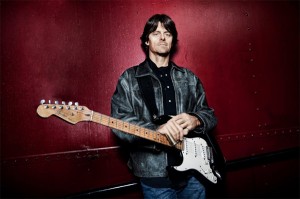
In the past year’s festival, Shawn Jones was featured with his album “Struggle Makes You Stronger.” The album is reminiscent of Cal’s search for masculinity, and finding an identity through physical labor.


As a side note, American culture has also embraced the blues and exposed children of our generation to the soul-filled sounds. In an episode of the Nickelodeon sitcom Drake and Josh, the boys perform “Soul Man” by The Blues Brothers.

Overall, the struggles underlined throughout Cal such as the need for equality and a desire to embrace masculinity had a strong overlap with common blues themes. This led Cal to seek out blues music as a refuge from the troubles and identify with others who experienced adversity of a similar nature and translated their problems into art. While blues music progresses over time, its foundation will always lie in countering sadness, whether it be right in the deep south or amidst the strife of Northern Ireland.

Van Morrison and the Maritime Hotel (previous)

[1] “Gary Moore Official Website – Biography.” Gary Moore Official Website – Biography. N.p., n.d. Web. 12 Dec. 2014.

[2] “John Mayall & the Bluesbreakers.” Wikipedia. Wikimedia Foundation, 12 Nov. 2014. Web. 12 Dec. 2014.

[3] “B.B. King.” Wikipedia. Wikimedia Foundation, 12 Nov. 2014. Web. 12 Dec. 2014.

[4] “Everything You Need to Know About Hozier.” Fuse. N.p., n.d. Web. 12 Dec. 2014.
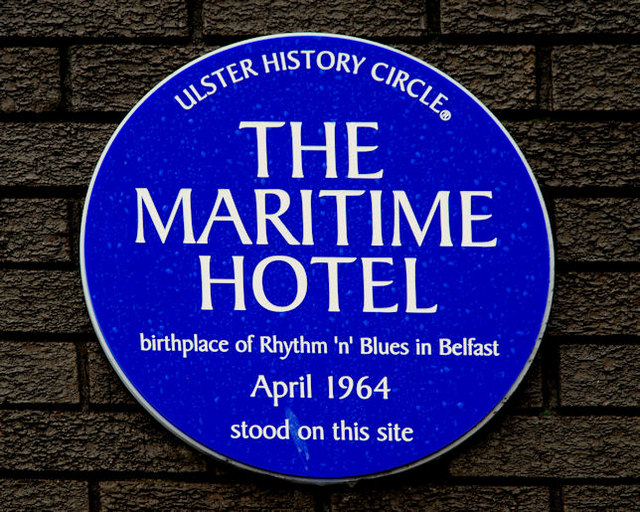
 

Van Morrison and the Maritime Hotel

Van Morrison and the Maritime Hotel

2259876_f90593c0

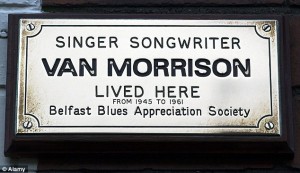
Image: plaque crediting the site of the Maritime Hotel [1]

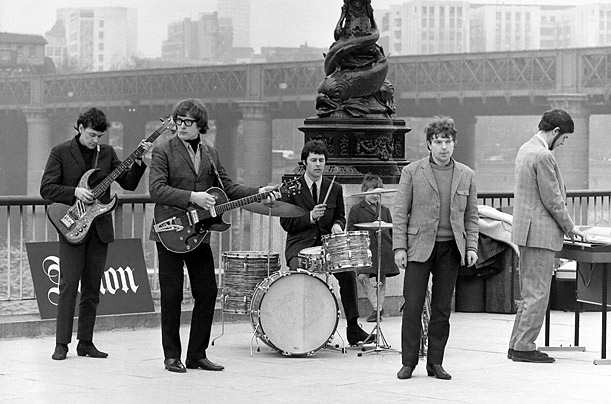
The Rhythm and Blues movement Blues gained awesome popularity in the 1960s. A major player in this movement was Van Morrison, singer in the band Them. Morrison created the R&B club at the Maritime Hotel in Belfast, which exploded into instant popularity. Maritime Hotel in Belfast was a hub for the blues, as it became central to the rhythm and blues movement, transforming the musical identity of the 60’s. [2]

van_morrison_02 Image: Them [4] This article relates the origins of Van Morrison, and the band Them, to the  celebrated Maritime Hotel.

article-2197246-14BC6079000005DC-24_634x367

Image: The Belfast Blues Appreciation Society is marking the past home of Van Morrison, signifying the importance of Morrison in the Blues community. [3]

The song by Van Morrison, “Into the Mystic” relates Irish elements, like the discovery of an essence and the search for a spiritual meaning. It is reminiscent of John Montague’s  poetry, where he is searching for an essence of Ireland, however he cannot find it. This is contrary to Yeats poetry, which is heavily reliant on a cultural nationalism and evoking a state of an ideal, celtic spirit. This spiritual concept of Ireland could only be enjoyed by the aristocracy, which in turn patronized Yeats’s work. Montague struggles with his identity because he was displaced at a young age, and doesn’t understand his nationality, or why he should be nationalistic.  In Morrison’s lyric, “Hark, now hear the sailors cry,” verbalizes that the sailors cannot find the essence. This searching for essence also questions the “essence” of home. “Into the Mystic” relates Morrison’s home-coming, another element of Irish identity, in the unfamiliarity in the home, or feeling of displacement in one’s nation.

“We were born before the wind
Also younger than the sun
Ere the bonnie boat was won as we sailed into the mystic
Hark, now hear the sailors cry
Smell the sea and feel the sky
Let your soul and spirit fly into the mystic”

Muddy Waters’s song “I Be’s Troubled” highlights characteristics of the Mississippi Delta blues. With this opening verse, the evident feeling of longing and desire relates to the stagnation of the Northern Irish political scene during the Troubles.

“I Be’s Troubled
Well if I feel tomorrow, like I feel today
I’m gonna pack my suitcase, and make my getaway
Lord I’m troubled, I’m all worried in mind
And I’m never bein’ satisfied, and I just can’t keep from cry in'”

Blues Influences (previous)

Modern Music (next)

[1] “Geograph – Photograph Every Grid Square.” Maritime Hotel Plaque, Belfast (C) Albert Bridge. N.p., n.d. Web. 12 Dec. 2014.
[2] Devlin, Patrick. “Maritime Hotel.” – Birthplace of Rhythm & Blues in Belfast. N.p., n.d. Web. 12 Dec. 2014.

[3] Caulfield, Annie. “Follow That Van: Taking a Musical Tour of Belfast in Search of the Great Van Morrison.” Mail Online. Associated Newspapers, 04 Sept. 2012. Web. 12 Dec. 2014

[4] “A Band with a Van.” LPCover Lover RSS. N.p., n.d. Web. 12 Dec. 2014.

Blues Influences

Spiritual songs helped deliver African Americans from political oppression and developed the blues style as a retaliation to this treatment. The blues applied to the Northern Irish situation due to both marginalized groups using pathos to define their identity. Specific references to blues songs and musicians in Cal include the working song “Take this Hammer” and Muddy Waters.

Muddywaters2

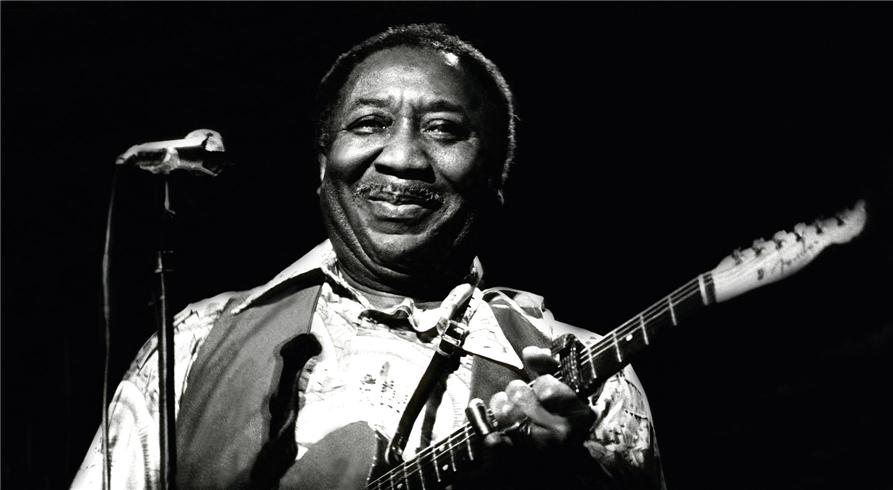
Image: Muddy Waters preforms at a club [1]

An example of Cal tying his own identity to the position of African Americans could be found while Cal was singing a traditional working song while cutting wood. Cal begins to sing a part of “Take this Hammer”. He sings, “Take this hamm-er, carry it to the cap-tain.” [2]. Here he directly compares his own position to that of a black laborer. By singing this song while doing labor for the sake of his father, he is reinforcing his subject position of being his father’s son. He is also reinforcing the position of Irish Catholics as the “hewers of wood and the drawers of water” [2]. This, coming from a priest teaching in a school, shows how embedded and widespread these sentiments are in Northern Irish society; he is reinforcing the notion that Irish Catholics are to Protestants as blacks are to whites in traditional America. This could allow for Catholics to feel justified in their violence towards Protestants.

“If he asks you was I runnin’

Tell him I was flyin’

If he asks you was I laughin’

Tell him I was cryin'”

Video: Leadbelly preforms “Take this Hammer”, as sung by Cal [3]. Lyrics

While observing Marcella in the library on page 14, Cal checks out a Muddy Waters tape. “Her gestures, the way she raised and rested the rim of her cup on her lip before sipping, every movement of her face hypnotized him. He chose a blues tape of Muddy Waters and went up to the counter and waited.” [2] Muddy Waters had a focus on the plight of the working man and created music that those marginalized by society could relate to. Muddy Waters was predominantly known for moving blues music from the deep South to Chicago in the United States. This theme of displacement is significant in both African American culture and Northern Irish Catholic culture, allowing for this sort of diffusion.

Video: Muddy Waters Blues Band singing Work Song which captures the essence of black soul music [4]


Literary Works and Media (previous)

Van Morrison and the Maritime Hotel (next)

Continue reading “Blues Influences”

Policing in Northern Ireland: An Introduction

Chase Chiamulera, Brian Dolan, and Katie Snider

Introduction

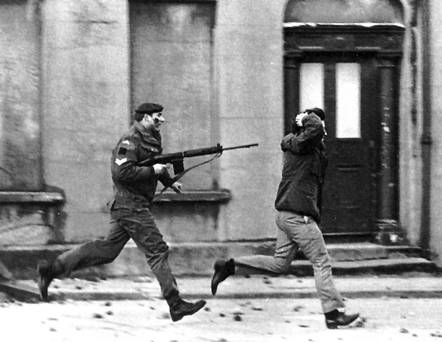
The overall purpose of this project is to highlight the ways in which the structure and strategy of policing in Northern Ireland created a climate of fear and discrimination for the working class Catholic residents of the country. This project makes use of a range of documents to establish a historical context of Northern Ireland’s policing problem in the late 1960’s and early 1970’s. Ultimately, the flashpoint of the policing issue in Northern Ireland was the tragic Bloody Sunday massacre on January 30, 1972.

FRED_HOARE_BloodySu_244817a

Image: A youth is arrested at gunpoint on Bloody Sunday

Through the use of documents such as Northern Ireland: The Plain Truth (1969), Seamus Heaney’s The Ministry of Fear and A Constable Calls, and written accounts from Eyewitness Bloody Sunday, this project aims to delineate clearly the degree to which policing strategies negatively affected the working class, Catholic population of Northern Ireland.

heaney

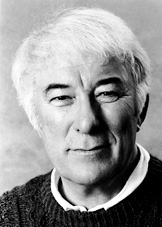
Image: Seamus Heaney, Irish Poet

Northern Ireland: The Plain Truth (1969) provides convincing eyewitness accounts of police brutality as well as startling statistics regarding the disproportionate representation of Protestants among Northern Ireland’s police forces. In this way, Northern Ireland: The Plain Truth provides a good starting point for understanding the extent of Northern Ireland’s policing problem. Heaney’s The Ministry of Fear and A Constable Calls provide a first-hand account of what life was like under the ever-present authority of Protestant police. The sentiments conveyed by Heaney in these two poems are reflective of the environment detailed throughout Northern Ireland: The Plain Truth.

Building on this contextual background, this project will describe in detail the tragic events that took place on Bloody Sunday, January 30, 1972. Bloody Sunday was not just an isolated and unfortunate incident of police brutality, rather, it was the culmination of a period of increasing belligerence on the part of Protestant police forces and was the direct result of systemic disproportionate representation and discrimination, as highlighted in Northern Ireland: The Plain Truth and throughout Heaney’s The Ministry of Fear and A Constable Calls.

Finally, this project will attempt to draw historical connections between the policing situation in Northern Ireland and more modern instances of police brutality and discrimination. Specifically, this project aims to establish connections between the situation in Northern Ireland in the late 1960’s and early 1970’s and the situation surrounding the Los Angeles riots in 1992 as well as the conditions in Ferguson, Missouri in 2014.

NEXT: The Plain Truth (1969)

ROADMAP

The Songs

This is the starter page for our project. Please select what Kendrick Lamar or Stiff Little Fingers song you would like to explore first. From there, you can use the hyperlinks to guide you through the remainder of the content.
Enjoy!

To examine what sources were used to inform our interpretations refer to our works consulted page.

Selections from Kendrick Lamar’s “Good Kid, m.A.A.d City:”

“Backseat Freestyle”

“The Art of Peer Pressure”

“Money Trees”

“Good Kid”

“m.A.A.d City”

“Sing About Me, I’m Dying of Thirst”

“Compton”

Selections from Stiff Little Fingers’ “Inflammable Material:”

“Here We Are Nowhere”

“Wasted Life”

“No More of That”

“White Noise”

“Law and Order”

“Alternative Ulster”

“Closed Groove”


“Money Trees”


‘Money Trees’ deals with issues Lamar finds living in an oppressed area of society, regarding how he identifies himself outside the paradigm of violence he lives within. There is also the issue of authenticity and how Lamar views his hip-hop heritage.

There is an interesting dichotomy in some of Lamar’s work that indicates a loyalty and pride in where he comes from, without condoning the inherent violence and crime. This is expressed in the first verse with seemingly contradictory lines. “Home invasion was persuasive, From nine to five I know it’s vacant, ya bish/Dreams of living life like rappers do, Back when condom wrappers wasn’t cool.” This line offers pieces of heritage that are negative, involving crime and misogynistic bad sex ed. This is followed at the end of the verse with, “You looking like an easy come up, ya bish/ A silver spoon I know you come from, ya bish, And that’s a lifestyle we never knew.” While this is aimed at people putting on an urban act, it reveals a sense of pride in coming from a difficult situation.

There is also a tension on Lamar from different sides in society. He is presented with two options for survival, working with the unfavorable oppressive government, “What else is a thug to do, When you eatin’ cheese from the government”, or falling in the violence and crime all around him, “Them serpents lurking, blood Bitches selling pussy, niggas selling drugs, but it’s all good.” The title, Money Trees, seems to be Lamar’s option out of such a dire situation. As Lamar states, “Money trees is the perfect place for shade,” and there is some acknowledgement that the only reprieve from the scorching violence of an oppressive situation is by means of capital. Ultimately this puts Lamar in a situation where obtaining wealth may compromise his heritage, but he rationalized this in the chorus, “Everybody gon’ respect the shooter, but the one in front of the gun lives forever.”

[If you would like to refresh your interactive experience please pinback to the songs.]

“Law and Order”

The biting irony comes right out at the listener as soon as they notice the title. “Law and Order” certainly does not agree with Stiff Little Fingers’ depiction of the police force emasculating and attacking the locals and friends portrayed in the song. Through this improper use of emasculating violence comes a feeling of isolation, constant berating causing discomfort an alienation on one’s own home turf.

The ‘law’ here does not really uphold law, order or justice. They dispense anarchic violence; the police spend their time abusing those that do not have the status and power they hold: “I had a friend who was lifted by the law… They treated him like shit / Kicked him in the head and laughed when he bled / spat in his face and pulled his hair.” Whereas the violence portrayed in Kendrick Lamar’s tracks like ”Sing About Me” and “m.A.A.d City” revolves around guns, the violence portrayed here seems personal and vicious from the proximity. This is not pulling a trigger anymore but getting your hands on someone else. The street justice of Compton is not even this disordered, even though those that carry this out are supposed to be the figures of law and order – this is the critique that Stiff Little Fingers makes.

Through this violence comes feelings of not being welcome, consequently creating feelings of isolation. The same situation occurs in Bernard MacLaverty’s Cal with the titular character being burned out of his home and threatened by people who are on both sides of a war Cal wants no part of. Cal often feels alone due to these outside forces, this sense of unfairness and Stiff Little Fingers orate this struggle with confidence. “I don’t think like you” and “you’re just a pawn in their game / just another number you aint got no name” describes an individual struggling against the situation around him, not really fitting into the system.

Violence is forced on Cal just as it is forced on the innocents of “Law and Order” and the man in “No More of That.” All of these characters are isolated by their horrible situations. Stiff Little Fingers does not offer a solution to this isolation caused by unfair violence; they only offer their view that the situation “isn’t fair”, that with the current situation “there’s o justice in it / None!”

[If you would like to refresh your interactive experience please pinback to the songs.]

“White Noise”

“White Noise” is the most troubling track on “Inflammable Material.” The song is made up of several racial epithets, each verse targeting a specific group of oppressed individuals. However, the song should not be understood as a racist outpouring but, rather, a tongue-in-cheek act that exposes the absurdity in the language used to oppress individuals. “White Noise” also roots this language to White, Anglo-Saxon narratives–the Brits. Irony, therefore, is a key feature in punk.

The first verse of “White Noise” draws on the language and ideas discussed in “Backseat Freestyle,” describing the virility of black men and the necessity to lynch these individuals to protect white masculinity: “Black golly gob. Big horny monkey / Pimp pusher coon. Grinning piccaninnies. Send him home soon. Back to the trees.” The second verse deals with the Islamic, Paki experience in the United Kingdom and Brits’ xenophobia: “Ahmed is a Paki. Curry coffee queer…/…Tax-sponging canker. Smelly thieving kids. Ponce greasy wanker. Worse than the yids.” Lastly, the third verse draws on language used against Irishmen: “Paddy is a moron. Spud thick Mick. / Breeds like a rabbit. Thinks with his prick. / Anything floors him if he can’t fight or drink it. / Round them up in Ulster. Tow it out and sink it.” The fear of virility that emasculated African-Americans was used against Irishmen. Stiff Little Fingers, most importantly, exposed how language universally effected oppressed individuals. Irishmen and blacks were believed to be sexual deviants, and arabs were thought of as dirty effeminate figures. Language solidified these stigmas and provided a vehicle to distribute and permeate oppressive thinking.

powder
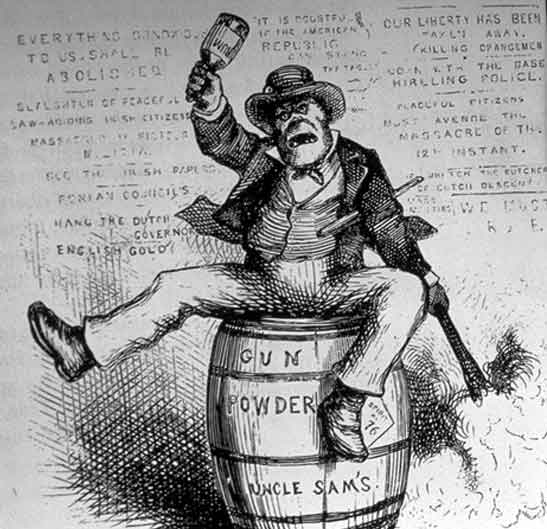
A racist caricature of a drunken, carless Irishmen.

Listeners may be upset or disgusted by this language but that is Stiff Little Fingers’ intention. As was referenced in the discussion of “Here We are Nowhere,” punk was a reaction to the over saturation of post-modern living. Post-modernity conflated certain ideas and aesthetics that over stimulated individuals, causing them to misunderstand their own individuality. This framework caused peoples to assess the language they used to comprehend reality. Racialized language, thus, exposed how individuals were hegemonically defined as deviant. Stiff Little Fingers, by sarcastically exposing and shouting this language, subverted their meanings and exposed the absurdity behind language as it debilitates one’s thinking. These words are giving meaning and value when they are used against certain communities. Stiff Little Fingers expose universality in their music by appropriating and subverting language. Stiff Little Fingers claim that the tactic of shouting this language is the only way to destabilize society’s oppressive ideology–the basis that normalizes and accepts oppressive systems. Simply by turning “up the white noise!,” the language of white-male supremacy, can individuals realize its absurdity.

[If you would like to refresh your interactive experience please pinback to the songs.]

“Closed Groove”

When considering Stiff Little Finger’s music, it is important to note their punk origin. Being punk, there is a level of tension with the society they live in. Being from Northern Ireland, the society Stiff Little Fingers are in tension with is highly divided and sectarian. What they are most opposed to are ideological extremists, who tend to proliferate violence. The song, “Closed Groove,” shows Stiff Little Finger’s as a band resisting a “Do what you’re told to be free,” mentality, while searching for identity.

The lyrics from “Closed Groove” decidedly dismiss what Stiff Little Fingers perceive as tired ideological rhetoric. The chorus mocks pre-existing forces fighting for their ideals: “Beep Beep, I’ve got very strong views, Plug in any tape you choose.” This establishes both Catholic and Protestant ideology as poignant but interchangeable, as both sides use the same violent means. Stiff Little Fingers also aptly address the rigidity in the extremes of sectarian Northern Ireland with the unassuming line, “Think what you like – if you agree with me.” This distance between ideological extremes is described by John Conroy in Belfast Diary, as a no man’s land. Because the numerous negative connotations, an insistence for the superseding of extremist ideology is called: “Nostalgia is past its prime, History’s a thing of the past.”

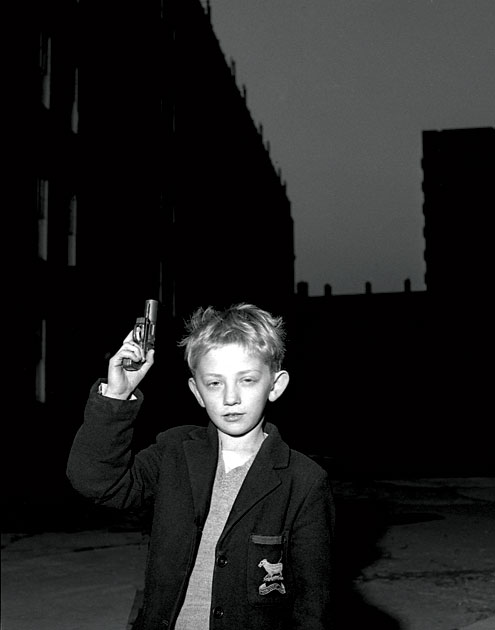
Out-take album photo from Inflammable Material- There are a few photos used by Stiff Little Fingers showing children with guns or near soldiers, possibly bringing to light how ingrained sectarian tensions are in Northern Irish society.

Stiff Little Fingers search for their own voice amidst antiquated rhetoric by rejecting established sectarian views – “I’m changing my views constantly.” The last lines in “Closed Groove” are a cry for autonomy and self-identity. “Speak whenever you hear this tone, Scream whenever you hear this tone” –literally a cry for like-minded people who aren’t indoctrinated by extremist ideology. Stiff Little Fingers refuse to identify with either extremes in Northern Ireland and react the only way they can. Singer Jake Burns in an interview states that “Inflammable Material,” “Reflects what we sounded like at the time – Raw, raucous and full of anger” (Louder than War).

[If you would like to refresh your interactive experience please pinback to the songs.]


“No More of That”

Like “Here We are Nowhere,” this Stiff Little Fingers track is short, but the succinct nature only supports and strengthens a clear argument purported through the lyrics. In just over two minutes Stiff Little Fingers delivers a powerful message on how violence defines masculine identity, forces it to become based primarily in this violence.

The message of this song comes in its final verse:

The man who pulls the trigger’s not to blame 

He’s only playing their deadly game

And he knows he just can’t win 

Or someone else will pull the trigger on him.

While this message echoes strongly in the tale of the first character of Lamar’s “Sing About Me,” it also operates fine all on its own. Here Stiff Little Fingers is almost excusing the man himself for the killing and violence he perpetuates. They blame the misguided actions of individuals on the situations they have been forced into. If someone is put into a violent culture, it is not their fault when forced into violent action. The man is alone; he has no choice, no free will as the situation has forced his hand. The man has no control over his own identity – it has been decided by the situation. It does not matter what his thoughts on violence are; the situation has forced the violence onto him, as it did for Cal in Bernard MacLaverty’s novel and the characters of “Law and Order.” The man has been isolated by the situation, and his masculine identity has been chosen for him. His fate has been sealed, and much like the other Stiff Little Fingers tracks there does not seem to be an offered reprieve form this eventuality. The band rarely seems to have the answers to the problems they bring to light, but with “No More of That” they come to that conclusion quicker than usual.

[If you would like to refresh your interactive experience please pinback to the songs.]