 In the early modern period, a cultural shift known as the “Reformation of Manners” occurred. Codes of etiquette – including habits of mealtime manners that we today take for granted – emerged out of the middle class and aristocracy. At the same time, new consumer goods (including such as silverware, table linens, and dishes) and rare commodities arriving through global trade networks (including sugar, coffee, chocolate, tobacco, and tea) marked status in the midst of rapidly changing social class structures.
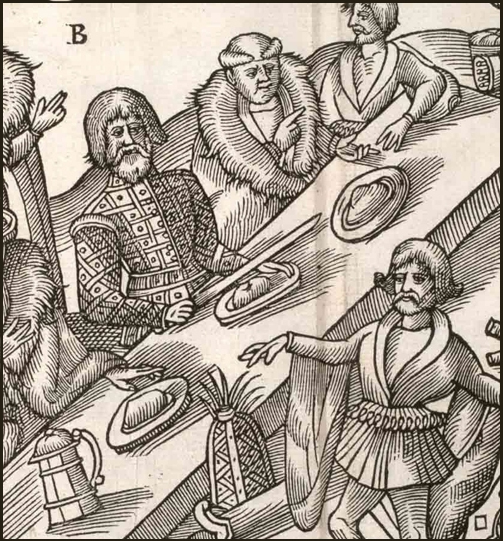
In Ireland, English observers emphasized the absence of manners and etiquette, particularly at the table. In Derricke’s image above, the leader of the Irish band of raiders sits at a plain wood board placed on the ground, mixes with men of lower class origins (including the two men warming themselves by the fire), and uses his battle sword to carve the meat. Derricke’s middle- to upper-class, literate, and English audience would almost certainly have noted the conspicuous lack of etiquette – and by extension, civility – in the feast scene depicted in this woodcut.
Derricke was not alone in critiquing Irish manners at the dinner table. Fynes Moryson, for example, claimed that at feasts the Irish “swallow whole lumps of filthy butter”.[1] Others noted the widespread consumption of a kind of porridge made from “oatmeal and butter [which] they cram together”.[2] Moryson also noted the mixing of men and women at social events as a major problem in Irish culture. In a feast held in Cork, for example, he wrote that in the dining chamber “I have seen with these eyes young maids stark naked grinding of corn with certain stones to make cakes thereof, and striking off into the tub of meal, such relics thereof as stuck on their belly, thighs and more unseemly parts.”[3]
Moryson also deployed reference to Irish intemperance. Although he praised the medicinal effects of Irish whiskey, Moryson lamented the fact that Irish celebrations often descended into drunken riots involving mixed companies of men and women:
in many families (especially at feasts) both men and women use excess therein. And since I have in part seen, and often heard from other experience, that some gentlewomen are so free in this excess, as they would kneeling upon the knee and otherwise [drink] health after health with men; not to speak of the wives of Irish lords or to refer it to the due place, who often drink till they be drunken, or, at least, till they void urine in full assemblies of men.[4]
[1] Moryson, Itinerary, 198.
[2] Campion, History of Ireland, 25. Also Richard Stanihurst, A Treatise Containing a Plain and Perfect Description of Ireland in Raphael Holinshed, The Chronicles of England, Scotland and Ireland, vol. vi (London: 1577), 67.
[3] Moryson, Itinerary, 197.
[4] http://www.ucc.ie/celt/online/T100071.html.