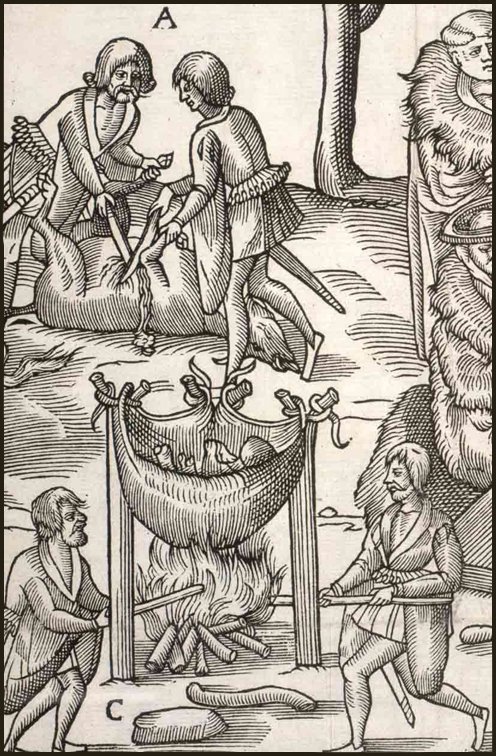
 The preparation of meats in Ireland provoked English disgust. Several commentators noted the lack of cookware among the native Irish, resulting in the widespread practice of cooking beef “lapped in a raw cow’s hide and so set over the fire”.[1] John Derricke’s account of Irish feasting in The Image of Ireland complained that the Irish promiscuously mixed the places where livestock was slaughtered, where food was cooked, and where meals were consumed. In an extended passage about food preparation, Derricke wrote:
…beeves are knocked down,
the butchers play their part,
They take each one the entrails forth,
the liver with the heart.
And being breathing new,
th’ unwashen puddings they:
Upon the coals or embers hot,
for want of gridiron lay.
And scarce not half enough,
(dress serveth well for hogs:)
They take them up and fall thereto,
like ravening hungry dogs.
Devouring gut and limb,
no part doth come amiss:
Whose lips and chappes with blood do swim,
most true repast is this.[2]
The consumption of rotten or corrupted food also drew English writers’ notice. Multiple writers noted with horror that the Irish “scarce strained” their milk, so that it was “usually stuffed with that which is not fit to be named, much less to be used”.[3] The preparation of “milk that is soured to the condition of buttermilk”, another staple of the Irish diet, likewise disgusted English writers.[4] Fynes Moryson asserted that the cheese and butter produced in Ireland was so disgusting that “an English man would not touch it with his lips, though he were half starved”.[5] Moryson went so far as to assert that the native Irish would “eat no flesh, but that which dies of disease or otherwise of itself” and suggested that even the most foul carrion could not “’scape them for stinking”.[6] The repeated references to corrupt food in these accounts seem especially striking. In consuming food that was contaminated by feces, or moldy and rotten to the point of stinking, the Irish were literally consuming corruption. Little wonder, English writers implied, that a people used to eating corruption and filth were themselves corrupt and filthy.
[1] Fynes Moryson, An Itinerary Containing His Ten Years’ Travel, vol. iv (Glasgow: Glasgow University Press, 1908), 198-9.
[2] John Derricke, The Image of Ireland: With a Discovery of Woodkarne, ed. F.J. Sypher (Delmar NY: Scholars’ Facsimiles and Reprints, 1998), 53. Throughout this paper, spelling has been standardized to 21st century conventions.
[3] James Perrott, The Chronicle of Ireland 1584-1608, ed. Herbert Wood (Dublin: Stationery Office, 1933), 16; Moryson, Itinerary, 198.
[4] Luke Gernon, “A Discourse of Ireland, Anno 1620”, in C. Litton Falkiner (ed.), Illustrations of Irish History and Topography, Mainly of the Seventeenth Century (London: Longmans, Green and Co., 1904), 359; also Moryson, Itinerary, 200.
[5] Moryson, Itinerary, 197.
[6] Moryson, Itinerary, 200. See also Gerard Boate, Ireland’s Natural History in A Collection of Tracts and Treatises Illustrative of the Natural History, Antiquities, and the Political and Social State of Ireland, vol. I (Dublin: Alex. Thom and Sons, 1860), 146-7.