After the Anglo-Irish Treaty of 1922, there were many fears and anxieties for both Catholics and Protestants over what the state of Northern Ireland would be. They both felt that they were living in a country with their enemies. Protestants abolished any sort of power Catholics had in the government through gerrymandering and abolishing Proportional Representation when they gained control of the government. They wanted to take their power away because they felt that the Catholics wanted a United Ireland and would work towards that goal, which they did not want. They wanted to stay as a part of the United Kingdom because they saw themselves as British not Irish. Ian Paisley, leader of extremists Protestants that were against the Catholics, gave many speeches to his people instilling their fear of the other religion. He said “Protect us from the shackles of priestcraft.” This quote shows the type of fear he was making the people feel. He stopped Protestants from seeing Catholics as just people but made them see the Catholics as always out to get them and against their country.
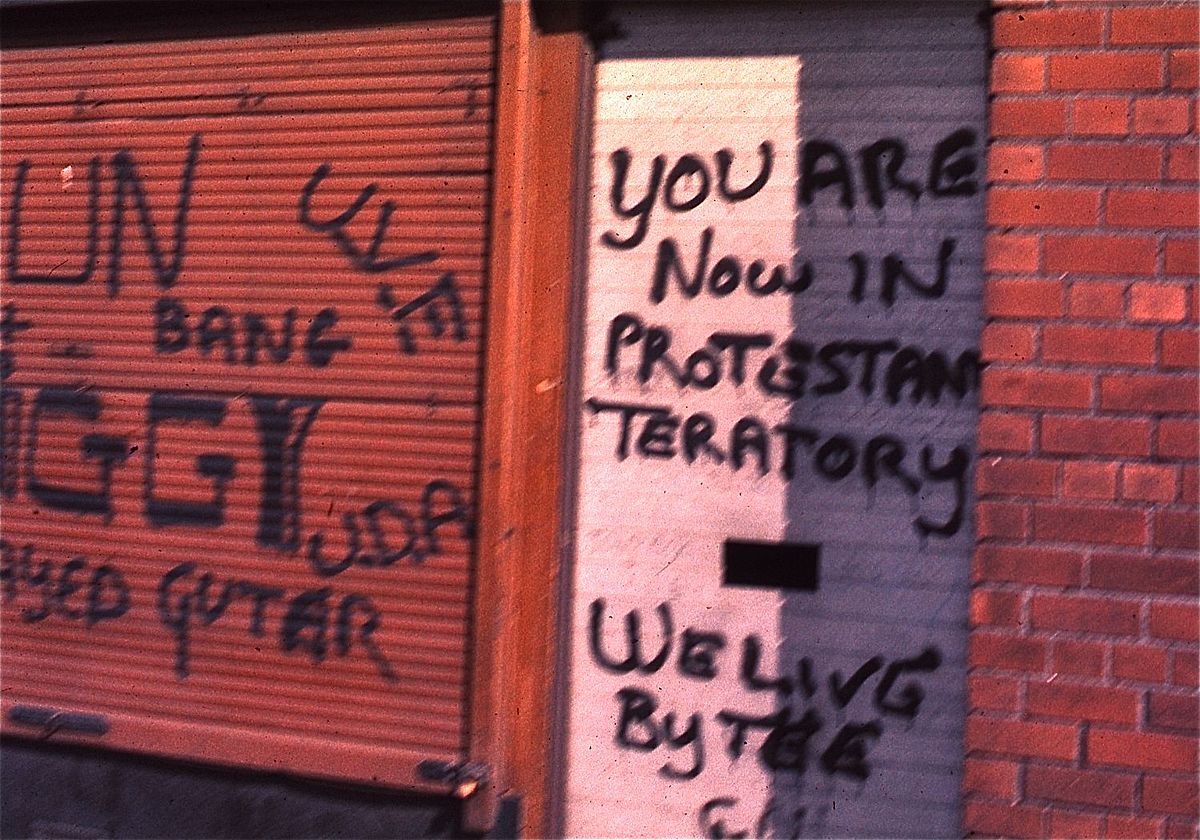
Graffiti in Belfast that shows the separation of territory between the two groups.
Meanwhile the Catholics where the minority in a country of people who looked down on them. The Catholics knew they were being barred from the government but there was nothing they could do. Being barred from jobs, new houses, as well as having the government and police against them made them unsure of their own and their families futures. In the book That’s That, the main character Colin and his friends are caught smoking weed by the cops and because of how they were raised they all instantly started giving the English cops wrong names, addresses, etc. This shows that they had no trust for the cops, they were not lying because they were caught doing something illegal; they were doing “just as they had been taught to do.” Before the Troubles started an economic downturn took place because the industries in Northern Ireland were beginning to become outdated. This recession caused mass unemployment and led to tensions between the two groups because they were fighting for jobs and Protestants thought the Catholics were trying to steal their jobs. This tension eventually boiled over and started the Troubles.
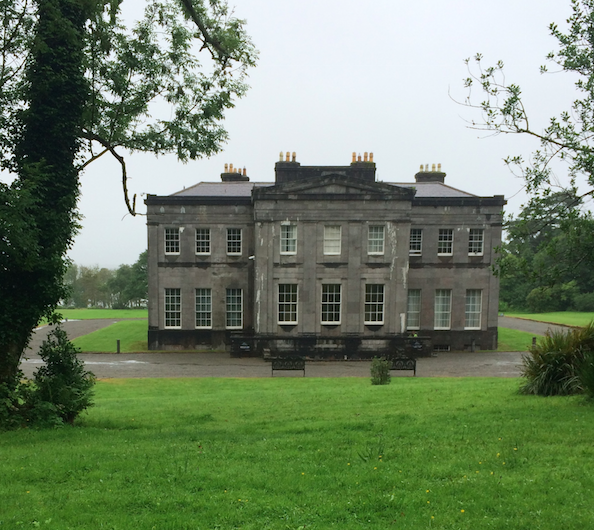
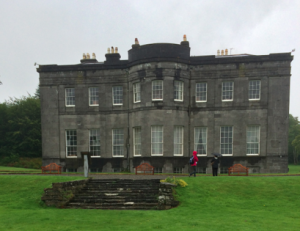
Lissadell House is a “Big House” built by the Ascendancy in the 1830s after a mysterious demolition of the old property on the Lissadell land. At this time, Sir Robert Gore-Booth (4th Bt) commissioned Francis Goodwin as architect to build the Georgian mansion on the 30,000 acres of estate. For an equivalent of approximately one hundred million euros today, Gore-Booth had one of the most impressive estates in Ireland and England of the time. According to records held by the United Kingdom (not Ireland, which is interesting) the neoclassical style, which could be viewed as imposing, was a welcome addition to the view matching the scenery nicely.
Considering their ownership of so much land, the Gore-Booths were responsible for multitudes of tenants during the Great Famine. While on the tours the guides will tell you how very kindly the owners handled their tenants, Sir Robert Gore-Booth did have a reputation for hiring his own “coffin ship” for his tenants. According to the archives from the Public Record Office of Northern Ireland, he has over three volumes of records of tenants, and numerous miscellaneous letters on sending “dispossessed tenants of Gore-Booth farms of Ballygilgan” to America. There are also numerous volumes on the relief programs the house held, including the soup kitchen where Caroline Gore-Booth set up and, according to the modern owners, often served “up to 200 gallons per day”.
Sir Robert’s son Henry gave birth to four children, two of which were Constance and Eva, who are mentioned in Yeats’ poem. Constance, the oldest, was largely notable for her political involvement. Married to Count Markievicz of Ukraine, she was able to rise in politics from painter and an Irish nationalist. Constance became a leader in the 1916 Rising, the first female minister in the world (in the first Dail), and a founding member of Fianna Fail.
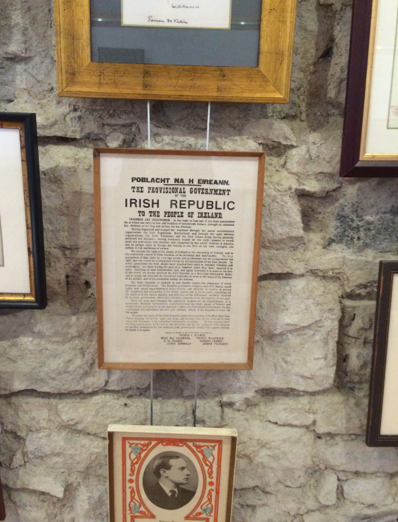
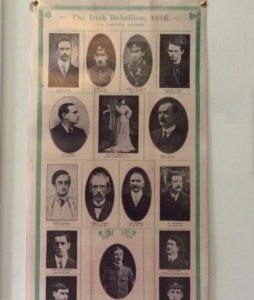
Writings on the Irish Republic from the Provisional Government on Display at Lissadell House“The Irish Rebellion, 1916” Photographs of the leaders of the 1916 rising with Constance Markievicz in the middle of the second row On display in the Lissadell Tea Rooms
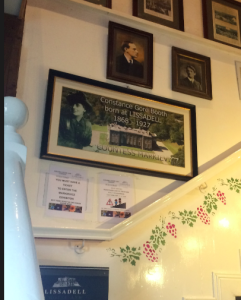
The entrance to the Con Markievicz exhibit in Lissadell
Eva Gore-Booth, the other subject of Yeats’ poem “In Memory of Eva Gore-Booth and Con Markievicz” was a renowned suffragette. Her extreme involvement in a cause that sought to increase women’s rights in matters outside of the aesthetic realm did not particularly please her friend W.B. Yeats as he demonstrated in his poem.
Their third sibling, Josslyn, was the next heir to the estate. Under his rule, he maintained even better relations with tenants, even selling 28,000 acres of the land fairly (according to sources now) under the 1903 Whyndam Land Act. Josslyn’s generation marked the last before the decline of the house that lasted through the 1990s, in which only three rooms and the kitchen were occupied. The rest of the home and grounds remained in disarray until the present owners bought the estate in 2003.
Yeats in Lissadell
W.B. Yeats, who spent much of his childhood in Sligo, had attended horse racing and cricket matches at Lissadell House. Later on, an established poet and fervent admirer of the aristocracy, Yeats visited Lissadell House when Eva Gore-Booth and Con Markievicz resided there in 1894 and 1895. Dr. Joseph Valente, a lecturer at the Yeats Summer School, pointed out following the tour that Yeats slept above the portico when he visited the home. This means that although Yeats revered the aristocracy, and had moved up enough in the social classes to visit Lissadell House, he was still not high enough to stay within the actual house.
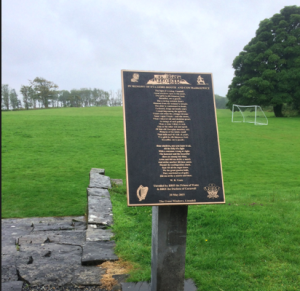
In 1927, he published the poem “In Memory of Eva Gore-Booth and Con Markievicz” which is displayed in numerous locations on the Lissadell property currently. However, to those who are familiar with the poem, as were the Yeats scholars with whom I toured the home, this is a bit puzzling. The poem does not portray either woman in a way in which one would think the owners would be proud of them.
While many aspects of this poem can be interpreted differently, the fact that Eva Gore-Booth and Con Markievicz are portrayed as beautiful aristocrats who did something wrong by placing value in something other than their wealth and beauty, is widely accepted.
In this poem, Yeats aestheticizes both Lissadell House and the girls, but in this he makes the point that the women grow older and politicized, thus losing their beauty. However, the house, as art maintained its aesthetic value which he portrayed both in the first two lines, when he did not use a verb with tense, giving an eternal image of the house. The speaker also says in lines 14-16 in the present tense, that “many a time I think to seek one or the other out and speak of that old Georgian mansion” despite the fact that at the present time the girls were dead. This emphasizes the fact that the girls could not last, but the house, as art–a purely aesthetic object–is eternal. Furthermore, in lines 12 and 13, it is made clear that Eva was made “old and skeleton-gaunt” because of her politics. That is, if she had only placed value in herself aesthetically, she would still be beautiful. In this case, the speaker works against himself. As he himself states, “the innocent and the beautiful have no enemy but time” (24-25). Time would go by whether Eva only dressed for tea and walked the garden, or fought for political causes she believed in, and lose her beauty in either process if time were indeed her only enemy.
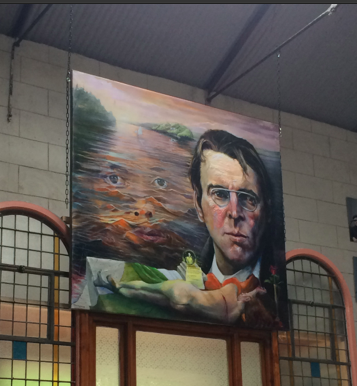
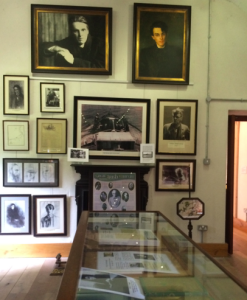
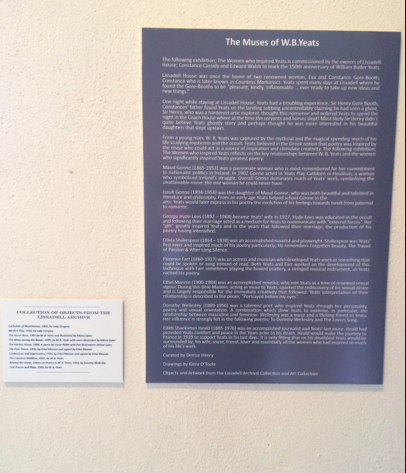
The WB Yeats exhibit in the stables of the houseThe entrance to the Muses of Yeats museum included the works of Oscar Wilde, Ezra Pound, and others
Modern Controversy
In 2003 Constance Cassidy and Eddie Walsh purchased the estate from Josslyn Gore-Booth reportedly for 3.75 million euros and have spent over 9 million euro since they purchased the home for their family of nine. The private purchase was news in itself, as Josslyn spoke on the record about how he would be “interested in the state buying it” and using it as a museum to its rich history. However, Cassidy and Walsh have restored it beautifully and have opened the basement and ground floor as a museum for the public while they live in the upper floors as a family.
However, there have been issues with litigation between the Cassidy/Walsh’s and Sligo County since 2008 over right of way through the property. There are four roadways that run through the property which, according to Sligo townspeople were used as public roads when the Gore-Booths owned the estate. However, according to the Cassidy/Walsh’s land agreement, they believed they owned the land and shut the gates, blocking the path of the public. They did so, reportedly, to protect the safety of their seven children who live in the home with them.
The situation resulted in litigation that resulted in a court ruling that the four access roads should remain public.In 2013 the Supreme Court ruled that “rights of way claimed by the local authority do not exist, in particular parking and right of way in front of the house” (“Family tell of relief after winning battle of Lissadell House rights of way”).
In 2014 however the home was able to reopen the basement and ground floors as museum space. The grounds are now open to visitors, yet pictures remain all over the museum portion of the home of the Cassidy/Walsh children.It also stands as a testament of Irish history, with the last Gore-Booths expressing that they wished the state would buy the home. However, as a Big House of Irish history the house stood for the wealth and oppression of the British in Ireland. Fittingly, there are pictures of the homeowners with multiple members of the British Royal family on display throughout the museum of Lissadell.
It is evident this is home to a family in certain regards, however. The backyard facing the lake has two football nets, and the pictures of the family throughout are simultaneously welcoming and also a bit of a threatening reminder. Nonetheless, the family is reported to have spent over nine million euro on renovation of the estate, and must bring in a good deal of revenue for the surrounding area of County Sligo.
Despite the controversy of the home, it undoubtedly provided inspiration for artists like both WB and Jack Yeats. Other extraordinary political leaders like Constance and Eva grew up there and were able to flourish to impact thecountry of Ireland in numerous ways.
Lissadell House view from backyard
Works Cited
Cassidy, Constance, and Eddie Walsh. “LISSADELL HOUSE & GARDENS.” Lissadell House and Gardens Sligo. Lissadell House, n.d. Web. 21 Aug. 2015.
“Introduction Lissadell Papers.” (n.d.): 3-46. Public Record Office of Northern Ireland. Crown Copyright, Nov. 2007. Web. 20 Aug. 2015.
“Family Tell of Relief after Winning Battle over Lissadell House Rights of Way.” (Irish) Independent [Dublin] 11 Nov. 2013: n. pag.
McGowan, Joe. “Lissadell House, Coffin Ships…” Sligoheritage.com. Joe McGowan, 2008. Web. 21 Aug. 2015. <http://www.sligoheritage.com/archpomano.htm>.
Siggins, Lorna. “Lissadell House in Sligo Set to Reopen to Public.” Editorial. The Irish Times [Dublin] 15 June 2014: n. pag. The Irish Times. 15 June 2014. Web. 18 Aug. 2015.
Belfast Giant H.E.R.O.S. is a program run by the professional hockey team of Belfast, the Belfast Giants. H.E.R.O.S. is a residential program, putting young people from Belfast, Holywood, and Dublin together to play hockey and participate in additional relationship-building activities. You can visit the Belfast Giant H.E.R.O.S. website here, and their page on the Ireland funds website here.
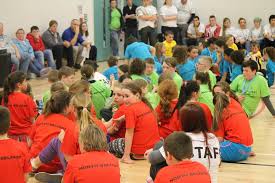
Participants in the Belfast Giant H.E.R.O.S. program.
PeacePlayers International is an international program, with a branch in Northern Ireland. PeacePlayer’s mission is uniting and educating young people through the sport of basketball. You can visit the PeacePlayers International website here, and their page on the Ireland Funds website here. Both the Belfast Giant H.E.R.O.S. and PeacePlayers International introduce sports not traditionally played in Northern Ireland. We perceive the use of a foreign sport as an attempt to remove recognizable context, which we explore more in our analysis.
Youth from Northern Ireland involved in PeacePlayers International.
In the case of these sports programs, by creating a set of rules on how one must conduct oneself, contained within defined boundaries, with teams created along non-sectarian-specific lines, we would argue these programs actually make it very difficult to orient oneself within pre-conceived notions of boundary and identity. Whether the programs make this move consciously or unconsciously, we argue that the end result is the same; it is far harder to map pre-conceived ideas on to dissimilar circumstances. As we noted before, the fact that the programs we examined focused on sports typically not played in Northern Ireland further obstructs an individual from aligning the ‘game’, or abstraction, along conventional sectarian divisions. Paradoxically, by seeming less real, we argue, it becomes easier to see that both the rules of games and the rules with which people define others’ identities are subjective and arbitrary.