Hidden Agenda was released in 1990 by Hemdale Film Corporation(UK) and Initial (II) (UK).

Paul Sullivan is an American civil rights lawyer and political activist visiting Northern Ireland with his wife Ingrid Jessner. During his visit, a member of the provisional IRA contacts him about a secret cassette tape and Sullivan is shot in his car. Investigator Peter Kerrigan who is assisted by Ingrid investigates the killing. The investigation reveals that the two men were shot without adequate warning and assumed to be assassinated; Sullivan for his alleged knowledge of the tape. The mysterious recording is found and discovered to have been made by a Captain Harris, an ex-army intelligence officer, now in hiding. The tape consists of senior military leaders and Conservative Party politicians talking about how they were responsible for the rise to power of Margaret Thatcher. After some time, Harris gives a copy of the tape to Ingrid, but British security forces kill Captain Harris, but blame his death on the IRA. Kerrigan is blackmailed into silence about the conspiracy. By the end of the film, Jessner still has the tape, but without Harris to confirm, the recording is virtually of no use in getting justice for her late husband.
The portrayal of the IRA in film tends to depict them as either tragic heroes, victims of British tyranny, or the criminal underbelly of the UK. In Hidden Agenda, members of the IRA and those supporting the organization are seekers of justice and truth with the common goal of exposing the corruption of the Thatcher administration. A specialized section of the English military, the MI5, are the only ones in the film responsible for any death or violence. This depiction, not uncommon in film and television, presents an inaccurate and purposefully distorted account of both the IRA and British paramilitaries in order to manipulate audience perceptions. Hidden Agenda is not so much explicitly responsible for evoking sympathy for the IRA because that is a natural jump to make when a film efficiently works to demonize the British government. Here is a scene where Ingrid and Peter Kerrigan discuss British involvement in the North. The film is worth note because of director Ken Loach’s noted interest in social issues. In Hidden Agenda, Loach, an Englishman himself, challenges British authoritarianism under Margaret Thatcher in response to The Troubles. In this way, it is distinct from other British media responses, which generally tended to demonize the IRA in favor of the British government and Protestant majority.
Ingrid Jessner and Peter Kerrigan discussing the state of the North and the British paramilitary.
[Home]

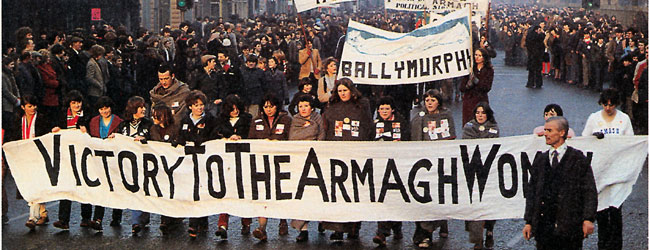
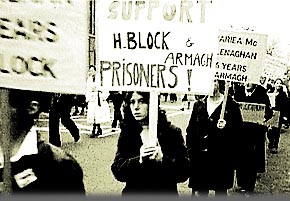
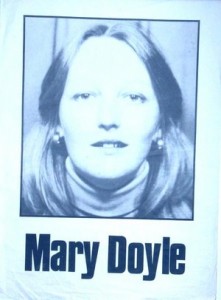 While seven men began a hunger strike on October 27th, 3 women from Armagh began the hunger strike on December 1, 1980. The three women who participated in the hunger strike were Mairead Farrell, Mairead Nugent, and Mary Doyle. The three girls were moved into a double cell together, and instead of the usual inedible cold prison food they were receiving before; they were fed with plates overflowing with piping hot food. After a couple of weeks on the hunger strike, the women heard rumors that the hunger strike was over, and that the men had ended the hunger strike. On December 19th they ended the hunger strike, and a sense of relief and happiness and satisfaction washed over the women believing that their demands would be met. But shortly after Christmas it became clear that the British had reneged on the agreement and had no intention of addressing the five demands. In January the women began discussing a second hunger strike, but with only 30 prisoners in their wing at the jail, they made the assessment that they would not be able to sustain a second hunger strike. But the women kept up with the no-work protest and supported their male comrades from their cells in Armagh. It is women who have been the backbone of the republican struggle. The women of Armagh were brave and sacrificed for their Irish freedom. For them, even though they received little attention, they still fought and struggled to ensure that their message was being heard.